Clocks fall back on Sunday, November 1. By the next afternoon a Nanaimo living room that still felt bright at four o'clock in October is in shade, and the lamp is on. Halloween is the night before, Saturday, October 31. After that the house is for the people who live in it, and they notice the view through the glass they sit beside.
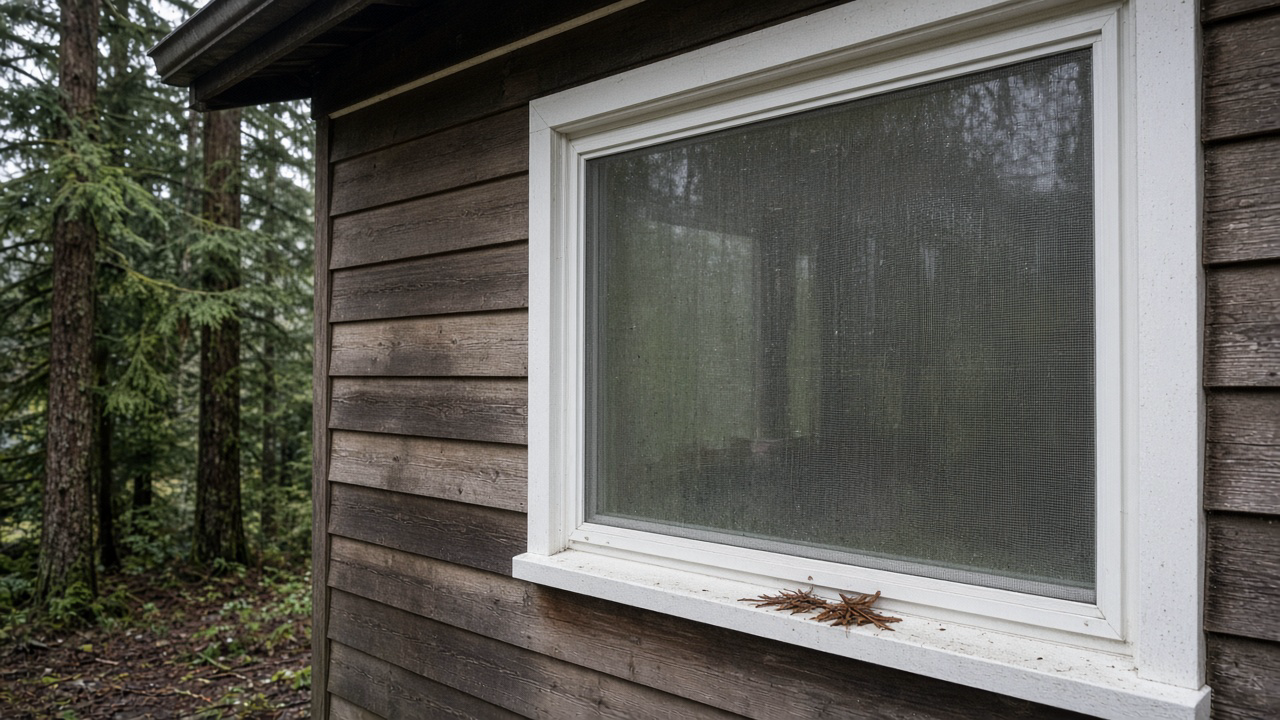
Mesh that has sat under Douglas fir and western red cedar since spring holds a grey film of needle dust, pollen, and, on a north wall, a green cast that never quite dried. Nanaimo receives over 1,100mm of rain a year. November rain wets that film. It does not wash it out of the weave.
This post stays on the screen: how to tell a dirty mesh from dirty glass, why the first week of November is when you notice it, and what a window visit covers. The September piece on fall window washing is the timing for the whole pane. The front entry guide is the walk and the door.
Why the room looks dimmer the week the clocks change
The mesh does not change at 2 a.m. on November 1. The light you see it in does. Sunset jumps earlier, so the hour you used to judge the room in daylight is now the hour you turn a lamp on. A screen that looked acceptable in June becomes the filter you live behind.
Shade finishes the job. Lots in Nanaimo, Lantzville, and Cedar often have fir or western red cedar over the wall. Parksville, Qualicum Beach, and parts of Ladysmith can have less canopy and still take a salt film off the Strait. A north bedroom under the eave stays damp between systems. The mesh there greens first.
The test from the chair
Sit where you actually sit. Slide one screen aside, or open the sash and look past the mesh at the same tree. If the view jumps brighter, the screen is the filter. If it stays milky with the screen off, the glass is filmed too. Do both. A clear pane behind a grey mesh still reads dull from the couch.
What cakes a Nanaimo screen by the end of October
Island screens do not fill with big maple leaves. The load is finer, and it locks into the weave.
- Cedar and fir dust. Western red cedar scales and Douglas fir needles break down on the sill and blow into the mesh. The dust is brown-grey. It does not sheet off in a shower.
- Pollen that rained on and dried. Spring and summer pollen sits in the holes. A dry wipe smears it. A wet November week turns it into a paste.
- Salt on the water side. Departure Bay, the Nanaimo waterfront, and the Oceanside stretch from Parksville to Qualicum Beach put a haze on mesh as well as glass. The coastal window guide is the longer salt piece. This one is the screen in short days.
- A green cast that never dries. North mesh, and mesh under a deep eave, grows a thin algae film. It looks like ordinary dirt until you hold it against a clean screen beside it.
- Splash off a full gutter. Cedar scales in the trough send dirty water onto the top of the upper screens. The mesh stains in a band. Gutter cleaning belongs with those windows. A hose from the flower bed only drives grit into the weave and soaks the track.
Screen, glass, or a repair
Name what you are looking through before you book. A house can have a grey screen on one wall and mineral spots on another.
| What you see from the chair | What it usually means | Sensible next step |
|---|---|---|
| The view jumps when you slide the screen | The mesh is loaded | Clean the screen. Wash the glass if the pane is filmed too |
| Still milky with the screen off | Film on the glass | Window washing, inside and out if the room side is dull |
| Grey only along the bottom rail | Debris in the track and on the sill | Frames, sills, and tracks with the glass |
| A brown band on the top of the upper screen | Overflow from the gutter above | Clear the trough and flush the downspout, then the screens |
| Rough white spots that stay with the screen off | Mineral film, sometimes etched | Say so on the quote. A standard wash may not lift it |
| Torn mesh, a popped spline, a bent frame | A repair, not a film | A screen shop or glazier before any wash |
Rough white spots are the subject of the hard water stains guide. Mention sprinklers if they hit that wall every morning. A wash will not change a watering schedule.
The same mesh shows up under fir and cedar in Parksville, Lantzville, Ladysmith, Cedar and Qualicum Beach. Salt on Oceanside screens, and a heavier dust load under the trees, do not change the test.
What early November is for, and what can wait
November is wet, with short days and a frost on clear nights between systems. You are lifting the film you will look through at dinner, not chasing a summer shine.
Remembrance Day is Wednesday, November 11. Rooms used that week, and through December visits, are the ones to book. A dry gap is enough for screens and the glass behind them. It will not hold a wash of every wall on the house.
Worth doing in the first half of November
- Screens on the rooms you use after three. Living room, kitchen, the bedroom that faces the trees. Slide one and check.
- The glass behind a screen that failed the test. Outside film and, if the room side is dull, the inside. Rain does not decide the interior.
- Tracks and sills full of scales. They feed the next film onto the bottom of the pane.
- A gutter staining the upper screens. Only when you can see the brown band or the overflow. Pair it with a full downspout flush.
Fine to leave until a longer dry stretch
- A spare room you do not sit in. Dim there does not change the evening.
- Outside glass washed in the last few weeks that only has new rain speckles. Speckles come back with the next system. A bonded film does not.
- A whole-house wash. Green walls are a separate job. Book the elevation that drips onto the screens unless the other walls match.
How a screen clean fits the rest of the house
Window washing here includes interior and exterior glass, frames, sills, and screens. Screens are removed, cleaned, and reinstalled. Tracks are cleaned where they can be reached. If you only want the mesh, say so. Grit left on the glass sheds back onto a clean screen at the next wind.
Order still matters. If moss on a sound roof is shedding onto that wall, moss removal and roof cleaning come first. Cracked tabs or a ceiling stain go to a roofer. Cleaning is not roof repair. Gutters come before the screens when the brown band is the clue. A green wall beside the window is house washing by soft washing: an eco-friendly biodegradable solution, dwell time, then a low-pressure rinse, finished before the glass so the rinse does not land on a pane you just cleared.
What to photograph from the yard
- The screen in place. From the chair if you can, and from outside. Grey weave, a green cast, or a brown top band.
- The same pane with the screen slid aside. So the quote can tell whether the glass is in the job.
- The sill and the track. Scales, algae in the corners, a torn corner of mesh.
- The eave above an upper screen. Overflow, a mossy shingle edge, or a downspout that misses the elbow.
- Second-storey access. Wet ground, a bed under the wall, a locked gate. Upper screens are a poor after-work ladder job once the clocks have changed. November lawns are slick, and the daylight is already gone.
What a visit will not fix
A wash lifts film off sound mesh and sound glass. It leaves the window itself alone.
- Torn mesh, a spline that has popped, or a frame that no longer sits square. That is a screen shop or a glazier. Washing a tear does not close it. A bent frame that will not clip back in needs a new screen.
- Fog between the panes. A failed sealed unit looks milky from any angle, screen on or off. That is a window contractor. A wash cannot clear the gap.
- Etched mineral spots. If the white roughness stays after the screen is off and a fingernail catches it, say so. A standard wash may lighten a surface film and still leave the etch.
- A window that leaks into the wall. A reachable track can be cleaned. Weep holes, a rotten sill, and a failed flange are a window contractor or a carpenter. Cleaning is not window repair.
- Outside glass you want spotless through every November system. Those panes will speckle again. The visit removes the bonded coat. It does not outrun the next front.
Pets stay inside while screens are off. Mention them on the form, and mention plants or a rain barrel if the siding beside the window is being soft washed the same day.
Questions from the living room
Will November rain clean the screens if I leave them? Rain moves loose dust. It wets the film already in the weave and leaves it there. By Remembrance Day you are looking through the same grey, in a shorter day.
Do I have to wash every window? No. Start with the rooms you use after mid-afternoon. A spare room can wait. A kitchen you eat in should not.
Can you do screens and leave the glass? Yes, if the pane passed the slide-aside test. If the glass is milky too, mesh alone leaves half the filter. Most visits do both, because the screen goes back over that pane.
We washed windows in September. Is the screen already done? If screens came off on that visit, you are looking at dust that has landed since. Use the slide test. New rain speckles on the outside glass are normal. A grey weave is a film, not a speckle.
Book the screens before the short days settle in
Slide one screen on a room you use after three. If the tree gets brighter, the mesh is part of the job. Book that wall for a dry gap in the first half of November, before Remembrance Day week and the visits that follow. A torn screen, fog between the panes, or a leak into the wall goes to a qualified contractor first. Cleaning is not that repair.
On the quote form you can choose Window Washing, Pressure Washing, House Washing / Soft Washing, Gutter Cleaning, Roof Cleaning & Moss Removal, Multiple Services, or Not Sure — Just Need a Quote. Ground-level photos of the screens, the same panes with the mesh slid aside, the sills, and any gutter band on the upper windows help us size the job before we arrive. We serve Nanaimo, Parksville, Lantzville, Ladysmith, Cedar, Qualicum Beach and surrounding central Vancouver Island communities, fully insured, with eco-friendly biodegradable soft-wash solutions on siding and roof work. House jobs start from residential services.