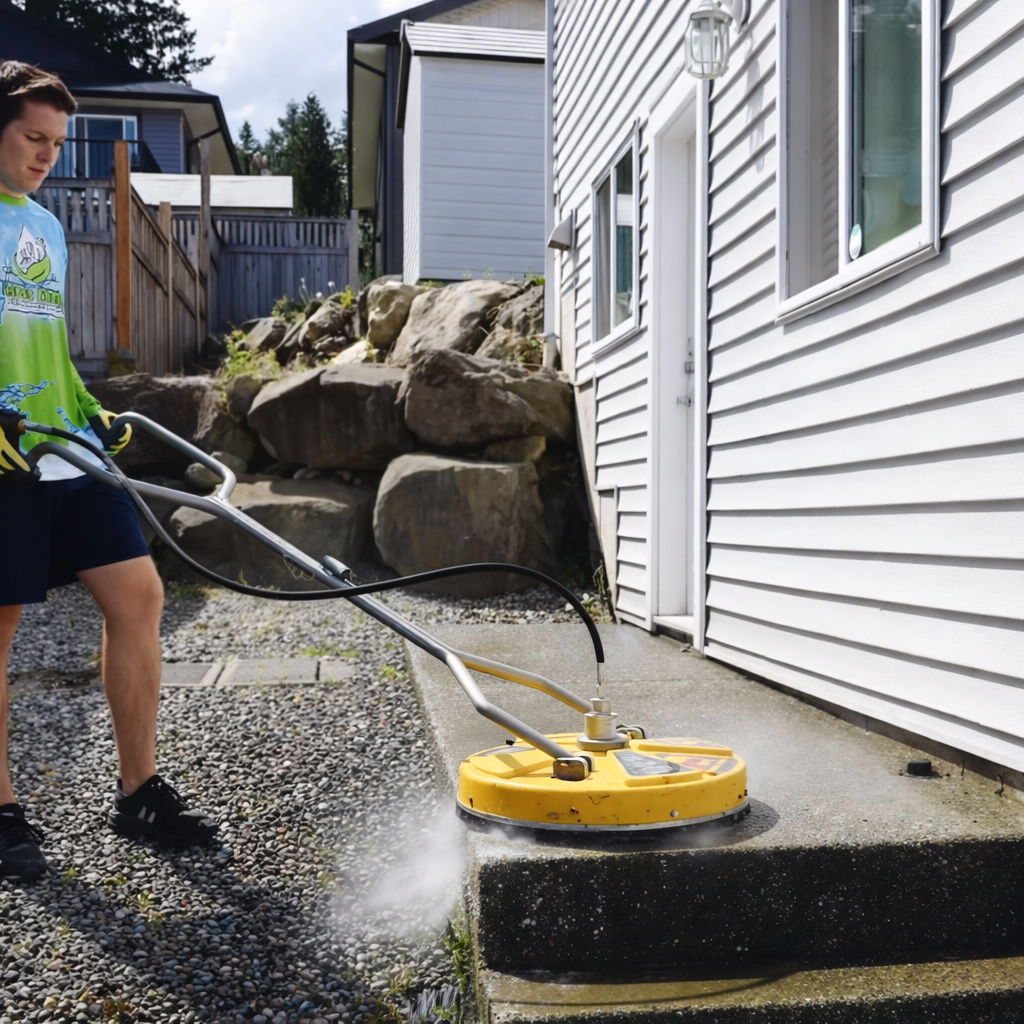
The first wet morning of October is when many Nanaimo homeowners notice it: the deck that felt fine in August suddenly grabs a sock or shoe sole. Outdoor stairs to the side yard look dark in the grooves. A thin green film sits where boards meet railing posts. Nobody fell — yet — but the surface no longer feels trustworthy when you carry groceries or let kids run out after dinner.
That is the Island deck-and-stair problem in fall. It is not the same job as clearing moss from a driveway or paver patio — wood and composite hold algae film, leaf mulch, and overnight damp differently than hardscape. If you live in Nanaimo, Parksville, Lantzville, Ladysmith, Qualicum Beach, or Cedar, treating those walking surfaces before wet season is a safety reset as much as a curb-appeal one.
This post stays on wooden decks and outdoor stairs. For moss on driveways, pavers, and patio stones, use our fall driveway and patio moss guide. Here: why boards and steps get slick, how soft wash and careful pressure fit wood, and what to tell a crew before you request a free quote.
Why Island decks and stairs get slick in fall
Central Vancouver Island does not dry out the way a prairie backyard does. Cedar and fir shade keep north-facing decks damp for days. Oceanside lots in Parksville and Qualicum Beach add humidity even with a thinner tree line. Forest-edge homes in Lantzville, Cedar, and parts of Ladysmith see the same pattern: a sunny street face looks fine while the back deck under the canopy stays wet from dusk to mid-morning.
Several things stack at once:
- Algae film on board faces — thin green or black film that looks like dirt until rain makes it slippery
- Moss in board gaps and stair nosings — needles, pollen, and moisture where biology takes hold
- Leaf and needle mulch — maple, alder, and cedar debris that stays wet overnight and feeds the film underneath
- Overnight damp — short fall days mean surfaces never fully dry between systems
- Shade and splash zones — under eaves, beside downspouts, and at the bottom of stair runs where runoff sits
You do not need a thick moss carpet for a slip risk. A smooth film on a painted stair tread or weathered cedar board is enough — especially for guests who do not know which step is the slick one.
Stairs and entries: the high-risk zones
Decks get the attention because they are large. Stairs and entries create the injuries. Outdoor runs from a back deck to the yard, basement walkouts, and short side-door steps see constant wet-shoe traffic — families, delivery drivers, and weekend guests on the same treads.
When you walk your Nanaimo property this week, look specifically at:
- Stair nosings and tread grooves — where algae and grit hold after a casual hose-down
- Landing boards at the top and bottom of a run — high-traffic, often shaded
- Transitions from deck to door threshold — the last step people take with full hands
- Handrail posts where boards meet — moss in the joint often means film on the walking surface nearby
A fall clean that brightens the open deck and skips the stair run misses the surface people actually trust with their weight.
Wood vs composite: what changes on site
Island homes run the full range — untreated cedar, stained or painted wood, and composite decking. Method follows material, not a one-wand-for-everything habit.
| Surface | What usually matters | Practical note |
|---|---|---|
| Cedar / softwood boards | Softer grain; film and moss in gaps | Gentle chemistry and controlled rinse over aggressive blasting |
| Stained or painted wood | Finish can etch or stripe if pressure is too high | Soft wash first; pressure only where the finish allows |
| Composite decking | Tougher than softwood, still holds algae film | Treat biology — “plastic” does not mean hose-only forever |
| Stair treads (any of the above) | Grooves and nosings hold grit + film | Detail walking edges, not only the open deck field |
On site, the crew matches approach to board condition, finish age, and how far biology has progressed. For the broader method conversation, see soft washing vs pressure washing.
Soft wash vs careful pressure on wood
For living biology — algae and moss — soft washing is usually the right starting frame: low pressure, a biodegradable cleaning solution, and dwell time so the film loosens instead of getting blasted into the grain. That is the same soft-wash logic we use on shade-side siding, adapted to horizontal walking surfaces.
Pressure washing still has a place when durable areas need a controlled rinse after treatment, stubborn grit sits in stair grooves after dwell, or adjacent hardscape (a concrete landing, for example) is bundled in the same visit.
What you want to avoid is treating a weathered cedar deck like a concrete driveway. High pressure on the wrong board can raise grain, strip finish, or leave tiger stripes worse than the film you started with. A careful crew chooses pressure and distance for the surface — not for speed alone.
Moss removal on decks is often the same visit: clear growth in gaps, treat film on faces, and leave the path usable before the next storm.
Pair lightly with hardscape — keep this post on wood
Many Nanaimo homes have a wood deck and a paver patio or concrete walk in the same backyard. Those hardscape surfaces deserve their own pass — algae on stones is a different texture and usually a different pressure profile. We already covered that in fall driveway and patio moss.
A smart fall booking might combine:
- Deck and outdoor stairs (this post’s scope)
- Pavers / driveway / patio stones (hardscape sister job)
- Optional house washing on the walls that face the deck — see also fall house washing before wet season
Order still matters if you want one visit to stick — roof rinse and gutter overflow should not land on a freshly cleaned deck. The one fall visit guide covers stacking exterior work without undoing finished surfaces.
Local patterns across Oceanside and mid-Island
The same slip risk shows up with slightly different causes: heavy cedar shade in North Nanaimo and Lantzville; Oceanside humidity in Parksville and Qualicum Beach; needle mulch in every board gap on Cedar and Ladysmith forest-edge lots; multi-level decks and long stair runs on central Nanaimo hillsides.
Wherever you are on that map, fall is still the window for a workable dry day — treat and rinse before wet season locks the film in for months.
What to photograph before you book
A quick walk with your phone beats a vague “the deck is green” note:
- Wide shot of the full deck and the stair run people actually use
- Close-ups of slick board faces, gap moss, and stair nosings
- Notes on wood vs composite, plus whether the finish is stained, painted, or bare
- Shade and tree cover (cedar drip line, Oceanside open lot, forest edge)
- Whether you want deck/stairs only or deck plus hardscape / house wash in one visit
Share those when you get a free quote. Clear photos of the worst treads help scope soft wash vs careful pressure without guessing from the street.
Common questions from Nanaimo homeowners
Is a garden hose enough before winter? A rinse removes loose leaves. It rarely removes the algae film that makes boards slick when wet — and fall is when that film matters most.
Will soft wash ruin my stain? Crews match chemistry and dwell to the surface. The bigger risk on wood is usually uncontrolled high pressure, not cleaning itself. Say what finish you have when you book.
Do composite decks need this? Yes if they hold film. Composite is not immune to Island algae; it just behaves differently than softwood under the wand.
Roof and gutters first? If they drip debris onto the deck, finish them before the deck reset — or stack them in one fall plan (see posts on the blog hub).
Clear the boards before wet season digs in
Slippery decks and outdoor stairs on Vancouver Island are a fall safety issue: algae film, moss in gaps, leaf mulch, and overnight damp turn trusted walking surfaces into guesswork. Soft wash treats the biology; careful pressure finishes where the material allows. Stairs and entries deserve as much attention as the open deck field.
Moss Bros. Exterior Cleaning helps homeowners across Nanaimo, Parksville, Lantzville, Ladysmith, Qualicum Beach, Cedar, and Oceanside plan deck and stair cleaning around Island weather. Send photos of the slickest boards and stair run, note wood or composite, and say whether you want walking surfaces only or a wider fall package.