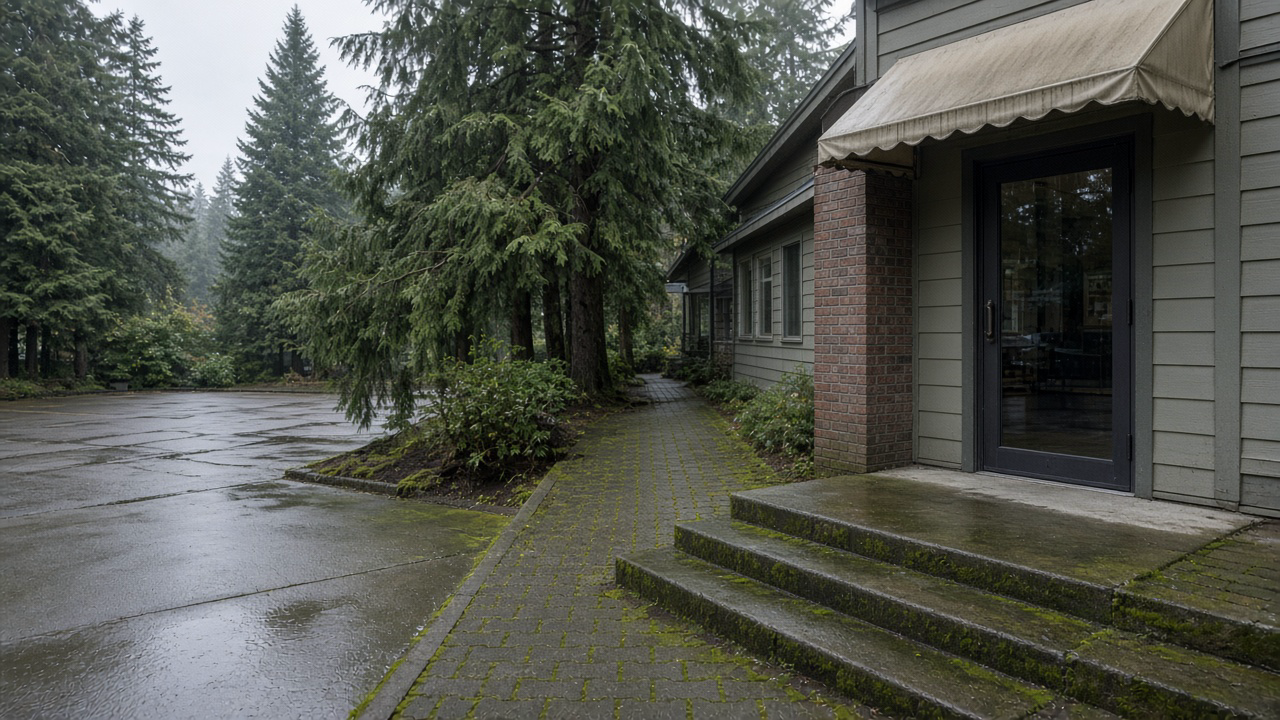
Clocks fell back on Sunday, November 1. By mid-afternoon a Nanaimo storefront is already in shade, and the concrete under the awning has not dried since the last shower. Holiday shoppers and strata guests use these doors through November, on the walk, the stairs, and the path from a visitor stall.
Steady rain does not rinse that surface clean. It keeps moss in the joints and a thin algae film on the flat, wet enough to skate under a shoe. Nanaimo receives over 1,100mm of rain a year. Early November is when short days and back-to-back systems stop the ground from drying. A green line that looked cosmetic in September is slick by Remembrance Day on Wednesday, November 11.
This post stays on those walking surfaces for businesses and stratas: entries, common walks, exterior stairs, and visitor parking. A house front step is the front entry guide. A home driveway is the driveway and patio guide. The wider September reset is the fall commercial exterior plan. Roofs, gutters, and glass are separate jobs.
Why the film thickens in November
A September afternoon still gives a walk hours of light. After the clocks change, that walk is in shade by mid-afternoon, and a canopy or a north entry may not see sun at all. Water stays in broom-finished concrete and in the sand of a paver joint.
Rain wets a dark film, shoes polish it, and the next system arrives before it dries. Douglas fir needles and western red cedar scales in the joints hold that damp, including under a drip line with no new hardwood leaves.
Shade does more than the forecast
Downtown Nanaimo stays grey, and a shop sidewalk takes foot traffic on concrete that never quite dries. North Nanaimo and Lantzville often have fir and cedar over the stalls, so the stall under the trees films first. Parksville and Qualicum Beach add Oceanside damp. Ladysmith and Cedar see the same green joints in a courtyard that misses a dry day. The sunny face can look fine while the door people use does not.
Where shoppers and residents put their feet
A wide lot can look fine from the street and still have two or three squares that matter. After a shower, walk the route a stranger would take.
The entry, the ramp, and the stairs
Under an awning, at a glass door, on a ramp, and on each stair nosing, the surface stays wet longer than the open walk. Moss sits in the crack. The film on the flat is easy to miss until a shoe skates. Lift the mat. It hides that edge.
A slick band only under a drip or a downspout means the walk is the symptom. Deal with that water path, or the film returns on the same patch.
Common walks and the path from the stalls
Courtyards, breezeways, and the walk from visitor parking carry the traffic. Paver joints pack moss first. Stall edges and curb cuts film where shoes stay on them. A covered walk may not dry this month, so photograph that stretch. A close jet can fade fresh stall paint, so say if the lines are new.
What a shoe tells you
- A sole that skates. Twist one foot on the entry and on each nosing. A slide means the film is already a walking problem.
- Green in the joints, dark on the flat. Moss in the seams is easy to see. The darker film on broom-finished concrete shows up when it is wet.
- A band under a drip. A stripe at a downspout, a scupper, or the awning edge means that square is being fed.
- Needles in the seams. A broom moves the loose layer. It does not kill what is rooted in the joint.
- A worse step than the open pad. Holiday traffic uses the change in level. A slick nosing outranks a tidy field.
What a short dry window can finish
Early November still has mild gaps between systems. They are shorter than September, and rain mid-visit rinses a treatment off before it has worked. A useful day leaves time for the solution to sit, then a rinse on the squares people walk.
Treat the growth, then rinse where the surface can take it
Soft washing puts an eco-friendly biodegradable solution on the growth at low pressure and leaves time for it to work. If the next system is an hour away, that dwell never happens and the solution leaves with the rain. Book the gap. Do not force the visit under steady rain.
Pressure washing belongs on sound concrete, brick, and durable pavers after the film has been treated. It lifts dirt and dead residue. A blast on its own can stripe the surface, carve soft joints, and leave growth in the pores. Commercial pressure washing is that work on a storefront, a common walk, or a lot. It is the wrong tool for a roof, painted cladding, or a stair that is already breaking up.
When the gap is only a few hours
Say so on the quote. A tight window can cover the door, the stair, the ramp, and the path from the visitor stalls. The far side of a large pad can wait. Wood treads, painted steps, and softer stone take soft washing. High pressure etches them and can blow out a weak nosing. A smooth sealed slab may come clean and still feel slick in the rain, because the sealer is what the shoe meets.
How to read the square in front of you
Match the next step to what the shower is showing. One property often has more than one of these on the same afternoon.
| What you see from the lot | What it usually means | Sensible next step |
|---|---|---|
| Dark film under the awning, shoe skates when wet | Algae on concrete that no longer dries | Soft-wash, then pressure-wash sound concrete |
| Moss in paver joints on a common walk | Growth in the seam, fed by shade and needles | Treat, then rinse. Do not gouge the sand out |
| A slick band only under a drip, downspout, or scupper | The walk is being soaked from above | Open the water path, then wash that square |
| Spalled nosing, a rocking paver, or a cracked curb cut | A repair, with film on top of it | A qualified contractor before a wash will hold |
| Smooth sealed concrete, slick even where it looks bare | The surface itself is smooth in the rain | Remove any film. Do not expect the wash to add grip |
Settle surfaces, hours, runoff, and access before anyone arrives. The commercial washing guide lists those questions. Commercial services covers the walks on their own or with the rest of the exterior.
What a wash will not fix, and what it will not promise
A clean entry is easier to walk. It is not a repair, and it is not a promise that nobody slips.
Broken surfaces stay broken
Spalled concrete, a loose nosing, a rocking paver, a heaved curb cut, and a handrail that moves are contractor work. A wash can make the damage easier to see. It does not patch, reset, or fasten it. If a tread already shifts, book the repair first. Washing a failing step can knock more of the edge away.
Film is only one reason a walk is slick
Rain on smooth concrete is still wet concrete. Leaves, a needle mat, ice on a clear night, oil in a stall, and a worn sole remain after the algae is gone. Oil is a different soil than moss. A biology wash may lighten a dark pad and still leave the stain, so say if oil is the complaint.
A wash does not install a non-slip coating. It removes the biological film, and growth under cedar or on a north entry comes back. November is a reset ahead of holiday traffic, not a bare surface until spring.
Keeping one door open while the walk is wet
The surface has to be wet to be cleaned. November foot traffic does not pause for that.
- Retail doors. Before open or after close keeps customers off a rinsed entry. With two doors, wash one while the other stays dry and in use.
- Strata walks. A note before a main path or the visitor aisle is wet keeps the morning from starting on a closed walk. Residents still need a way to the lobby.
- Name the water. Which bib the crew may use, and where the rinse may run: a storm drain, a bed, a lower walk, or a stall. A rinse that sheets onto the next entry only moves the problem.
- The square that is being fed. If a downspout or a flat-roof overflow soaks the same nosing every storm, commercial gutter cleaning belongs with the walk. A sidewalk wash does not open a roof drain.
A covered entry under trees often needs a fall and a late-fall visit, not one rescue the week the shops fill. Use the commercial quote form to say whether this is one November gap or a repeat through the wet season.
Questions from the lot
Will November rain wash the walks clean? Rain moves loose needles and wets the film. A walk that looked dusty in September can skate by the second week of the month.
Can the whole lot be done in one dry hour? Entries, stairs, ramps, and the path from the stalls come first in a short gap. A large pad, with dwell and a rinse, needs a real break. Say how long the site can be wet.
Does a wash mean nobody will slip? It removes moss and algae that make a wet surface worse. Smooth concrete, rain, ice, oil, and debris can still be slick. Cleaning is not a coating, not a repair, and not a guarantee.
We had the exterior done in September. Why book again? September had longer dry afternoons. November has added shade, rain, and needles in the joints. This month is the surface people use in the dark.
Book the walks before holiday traffic
After the next shower, look at the entry. A shoe that skates, moss in the joints, or a stair that stays dark is the November problem on a storefront or a strata walk. Book those squares while a mild gap still exists. A spalled nosing, a rocking paver, or a rail that moves goes to a contractor first. Cleaning is not that repair, and it is not a promise against every slip.
On the commercial quote form you can choose Commercial Window Washing, Commercial Pressure Washing, Commercial Soft Washing, Commercial Gutter Cleaning, Building Exterior Cleaning, Parking Lot / Concrete Washing, Recurring Maintenance Contract, Multiple Services, or Not Sure — Just Need a Quote. Ground-level photos of the entry, the stair nosings, the ramp, the paver joints, the path from the visitor stalls, and any drip that feeds them help us size the job before we arrive. Note the hours the doors have to stay open. We serve Nanaimo, Parksville, Lantzville, Ladysmith, Cedar, Qualicum Beach and surrounding central Vancouver Island communities, fully insured, with eco-friendly biodegradable soft-wash solutions where the growth needs treatment before a rinse. Walks and lots start from commercial services.