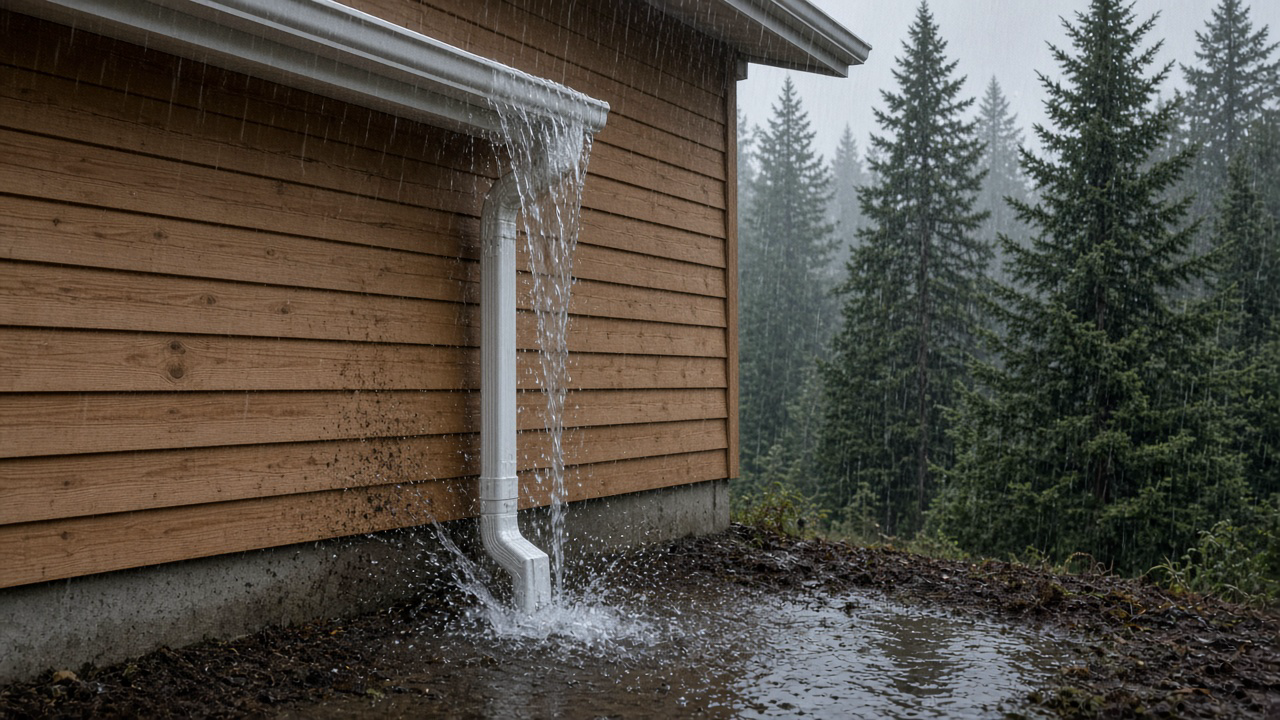
Late October is when central Vancouver Island stops hinting at wet season and starts it. The first heavy Pacific storms push steady rain across Nanaimo, and Douglas fir needles, cedar scales, broad leaves and bits of moss ride that water to the gutter. A trough that looked open on a dry afternoon can fail at one corner once the rain has volume.
The failure is often the downspout, or the elbows that turn it. The gutter can look ordinary from the driveway while one corner sheets, the pipe gurgles, and a puddle sits against the foundation.
This guide covers those signs, why a clean-looking gutter still overflows when the downspout is plugged, what a full downspout flush involves, the checks you can do from the ground, and when the corner is a repair for a qualified contractor. Cleaning is not gutter repair. Nanaimo receives over 1,100mm of rain a year, so a small plug becomes a repeated overflow once the storms stack up.
Why the first heavy rain finds the downspout
Through September and early October, debris arrives in pieces. Needles drop, wind shifts them, and a dry gutter holds a loose mat. A mid-October cedar needle flush is about that second load in the trough. Late October changes the test. A Pacific system sends a roof full of water to every outlet at once, and it carries the loose material with it.
Needles and leaves pack. Damp cedar and fir needles felt together, a broad leaf folds over the outlet hole, and shingle grit fills the gaps. The narrow points fail first: the drop where the trough meets the pipe, the upper elbow under the eave, and the lower elbow that kicks the spout onto a splash block or the soil.
Where Island lots send the water
A fir and cedar drip line feeds one corner harder than the street face: a north eave in Lantzville, a treed street in Parksville, a shaded side in Cedar, and lots in Qualicum Beach, Oceanside and Ladysmith. A September scoop of the trough does not promise October flow.
Signs a downspout or its elbows are blocked
Most of this can be read from the yard during one rain. Stay off the ladder. A one-storey eave is still a fall when the metal is wet.
- Water sheeting over the gutter at one corner. Other runs may still drain. Overflow at a single outlet usually means that pipe is plugged.
- Gurgling. An open downspout pours steadily. A partial plug makes the pipe gulp, often at the lower elbow.
- Splash marks. Dark streaks on the siding or fascia, or grit on the concrete under that corner, stay after the rain stops.
- Pooling at the foundation. A puddle, soft soil, or washed-out mulch under the outlet. That water returns with the next system.
- A damp lower wall or crawlspace on that side. A new damp line, a wet crawlspace vent, or a musty room beside the overflowing corner means roof water is reaching the house.
- A spout that barely drips. If the other downspouts run in the same shower and one is idle while the gutter above it is full, that pipe is the suspect.
- A lower elbow you can see from the ground. Needles collect where the water slows. A wad, a crushed section, or a slipped joint is worth a photo.
A guard slows how fast the trough fills. The elbows stay the choke points, which is why gutter guards still need cleaning on Island homes. This post stays on the pipe.
Why a clean gutter can still overflow
A gutter is a trough. A downspout is a pipe with turns. An empty channel can still hide a packed outlet and elbows behind the fascia. Water then sheets over the lip or spills onto the fascia.
Clearing the open channel by hand and with blowers removes what you can see. It does not prove the pipe is open. A full downspout flush is the test: water has to leave at the bottom in a steady stream. Gutter cleaning on our visits includes that flush on every downspout.
Three ways a clear trough still backs up
- The plug sits below the outlet. Needles bridged the hole, then dropped into the upper elbow. The trough was cleared. The elbow was not.
- The lower elbow is packed. Soil and last season's debris sit in the kickout. Water fills the pipe from the bottom, then the gutter, while the channel above looks tidy.
- The pipe is open and the trough still ponds. The gutter sags or the pitch runs the wrong way. Once a flush has shown the pipe is clear, that is a repair for a qualified contractor.
Moss removal and a fall storm loosen grit and dead growth, and the first hard rain carries that mix to the outlet. Shingle granules in the gutter are a separate question about the roof. In the downspout they add weight to the needle pack. The fall gutter cleaning checklist covers the whole run.
What a full downspout flush involves
Downspout flushing is part of the gutter clean. Every downspout is flushed with water, blockages are checked and cleared, and flow is confirmed all the way through.
The trough comes first
Leaves, pine needles, shingle grit and organic debris come out by hand and with blowers before water goes down the pipe. Flushing a full trough drives a fresh mat into the elbow. The open run has to be clear so the test is about the pipe.
Water through every downspout
Water is run through each spout, including the quiet corner on a two-storey wall. A plug shows up when water fails to arrive in a steady stream, or when it arrives in dirty bursts and then runs clear. An open pipe passes water continuously at the outlet.
The ground outlet counts
A spout that ends in a splash block, soil, or a buried pipe can be blocked at the end. Flow counts when water leaves. If an underground line still holds water after the above-ground pipe is open, that buried run is outside a gutter clean. Mention it when you book.
Height, and the notes that follow
Two- and three-storey houses get the same flush, with proper ladder work and fall protection. The condition report flags sagging, damaged or missing sections. A crushed spout stays crushed after the debris is gone.
Ground-level checks during one rain
Stay on the ground. These checks help you decide whether to book a clean, ask about a repair, or both.
- Watch one corner. Water should enter the outlet and leave at the bottom. Sheeting at that corner, while another spout runs, points at that pipe.
- Listen at the lower elbow. Gurgling means air is trapped behind a partial plug. A quiet, steady pour is what you want.
- Read the wall after the rain. Splash marks or grit on the concrete are the record of the last storm.
- Check the soil and the lower storey. Pooling, washed mulch, a wet crawlspace vent, or a new damp line means roof water is reaching the house.
- Look at the bottom elbow. Leave it assembled. A wad of needles, a crushed section, or a spout buried in soil is worth a photo.
- Look again once the rain stops. A pond left in the trough at one end is either a plug or bad pitch. Mention it when you book.
Yard photos of the corner, the lower elbow and any pooling are enough. A loose bottom elbow full of debris can be cleared by hand from the ground. Leave the upper sections alone, stay off the ladder, and keep a hose out of the spout. Forcing water up a packed elbow can seat the plug or open a joint. The full clear is done from the top, after the trough debris is out.
How to read the corner
A flush and a repair solve different problems. Match the rain you watched to the next step before the next Pacific system arrives.
| What you see | What it usually means | Sensible next step |
|---|---|---|
| Water sheets at one corner while other spouts run | A plug at that outlet or elbow | Gutter cleaning with a full downspout flush |
| The trough looks empty and the corner still overflows | A plug hidden in an elbow | Clear the trough, then flush from the top |
| A crushed spout, an open joint, or a missing section | Damage | A qualified contractor. Cleaning will not close it |
| The trough ponds though the pipe runs clear | A sag or bad pitch | Repair, once a flush has ruled out a plug |
| Water never appears and the pipe enters the ground | A buried drain past the spout | Flush the spout first. The underground line is separate |
When the corner is a repair
Cleaning removes debris and proves flow. It does not replace a downspout, reset the pitch, or close a split seam. Cleaning is not gutter repair.
- Crushed, split or disconnected metal. An elbow off the wall, a spout that misses the outlet, or a pinched section needs a qualified gutter contractor.
- A sag after the pipe is open. If the downspout runs clear and the trough still ponds, the pitch or the hangers are the issue.
- Separated seams or missing pieces. A gap at a joint, or a length pulled off the fascia, keeps wetting the wall.
- Overflow after a confirmed flush. A normal rain that still sheets at an open pipe is a capacity or pitch question.
- Water already inside. A leak into a crawlspace or lower room comes before a washing visit. Say so when you book.
We flag sagging, damaged or missing sections on the condition report so you can hand the notes to a contractor. Re-hanging gutters and rebuilding a buried drain are repair work.
If the roof above is feeding the plug
A mossy pitch refills a cleared pipe. Moss removal and roof cleaning on a sound roof use low-pressure soft washing with eco-friendly biodegradable solutions. Book the gutter flush with that work. Bald shingles, a leak or rotten fascia need a contractor before any wash.
Questions homeowners ask
The gutters were cleaned in September. Why is one corner overflowing now? Late October rain moves a fresh load into the outlet. The channel can be clear and the elbow can still plug weeks later.
Can I tell from the ground? Yes, for the decision to book. Sheeting, gurgling, splash marks and pooling show up at ground level. The flush checks the upper elbow you cannot see.
Book a downspout flush before the next system
The first heavy rain is the warning. Nanaimo, Parksville, Lantzville, Ladysmith, Cedar and Qualicum Beach still have more Pacific systems ahead, and a corner that sheets once will sheet again while the elbow stays packed. A full flush confirms the pipe. A condition note tells you whether the metal needs a contractor.
On the quote form you can choose Gutter Cleaning, Roof Cleaning & Moss Removal or Multiple Services. Ground-level photos of the overflowing corner, the lower elbow, splash marks on the siding, and any pooling at the foundation help us size the job before we arrive. We serve Nanaimo, Parksville, Lantzville, Ladysmith, Cedar, Qualicum Beach and surrounding central Vancouver Island communities, fully insured, with eco-friendly biodegradable soft-wash solutions on roof work.