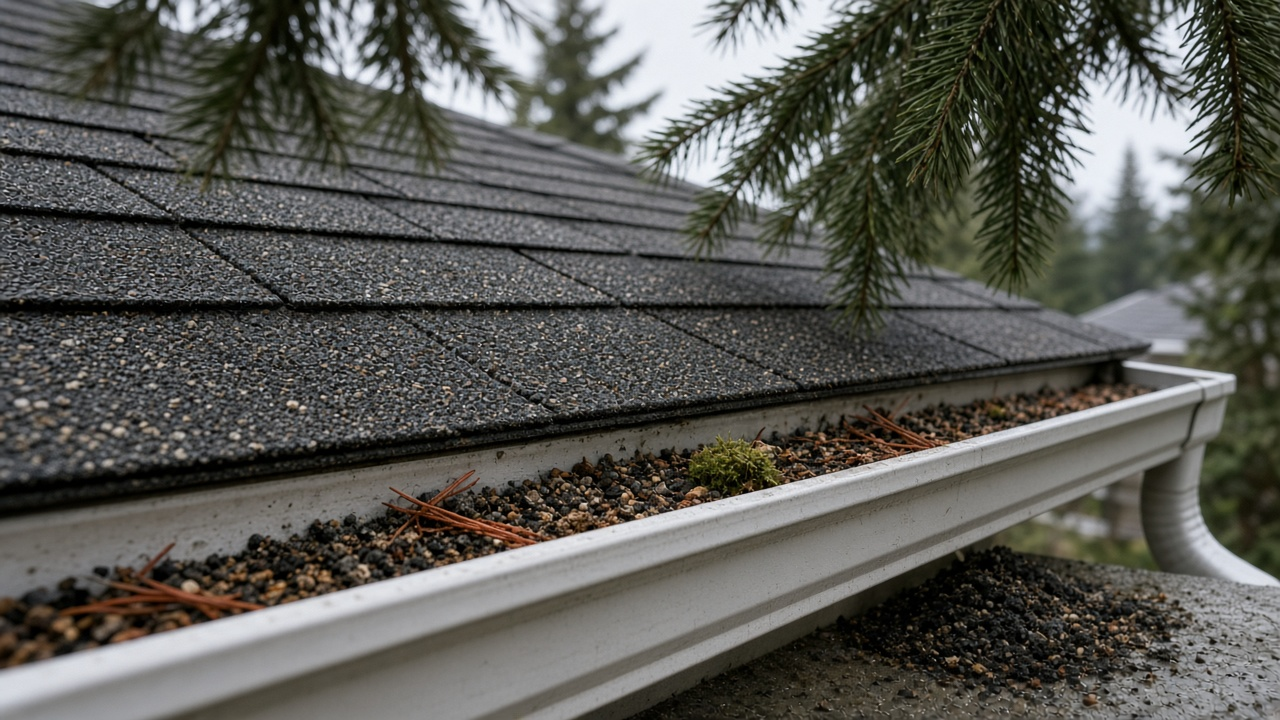
A coarse pile at the downspout, or grit mixed through the cedar needles in the gutter, is mineral granules from the asphalt shingles above. After moss removal or the first hard fall storm, Nanaimo homeowners ask the same question. Is the roof shedding normally, or is it wearing out?
Some granule loss is ordinary on asphalt. A heavy load, bare patches, or grit that returns after every rain can be a different story. Nanaimo receives over 1,100mm of rain a year, and Douglas fir and western red cedar keep many pitches damp. Moss holds water against the granule layer, and whatever the roof lets go of washes into the trough.
This guide covers what those granules are, what looks normal after a storm or a soft wash, how moss relates, and when a qualified roofer should look. Gutter cleaning and moss removal are not roof repair, and they are not a roof inspection.
What the grit in the gutter actually is
Asphalt shingles carry a mineral granule coating. Those grains shield the asphalt and give the roof its colour. Wind, rain, and years of coastal weather loosen some of them, and the next shower carries them into the eavestrough. On the Island that grit rarely arrives alone. Cedar and fir needles, moss fragments, and shingle grit pack together just before the outlet. Gutter cleaning takes that mix out by hand and with blowers, then flushes every downspout so a sandbar cannot sit unseen in the pipe.
Where you usually notice them
- In the trough itself, as a gritty layer under the needles, thickest near corners and outlets.
- At the downspout splash, on concrete, a splash block, or the soil beside the foundation.
- After a windstorm, stuck to moss that tore off the slope and landed in the gutter.
- The week after moss removal, when dead growth and anything already loose wash down with the first rains.
A metal roof does not shed this grit. Sand in that gutter is from somewhere else, often a neighbouring asphalt slope. Metal fall care is a separate job, covered in moss and algae on metal roofs.
What is a normal amount after a storm or a clean
There is no useful household count for too many granules. Watch the pattern: a light dusting in other debris, a one-time heavier flush, or a sandbar after every rain.
A light sprinkle through the season
Older asphalt roofs here give up a little grit every year. It hides in the needle mat until the trough is emptied. A thin mix with needles is common and, on its own, does not mean the roof is failing. Some roofs shed a little more in the first seasons after installation. We will not put a year count on that. Even coverage, seen from the ground, makes one dusty clean-out a drainage note.
The pile right after moss removal
A proper moss removal on asphalt is a low-pressure soft wash. It is meant to reach the growth without blasting granules off the shingles. High pressure can strip grains and void roofing warranties, so these roofs are not pressure washed. Extra grit can still follow a careful wash, because moss often already holds loose grains and the next rain carries them down. That first flush should taper. A fresh sandbar after every later storm is a reason for a roofer to see the surface.
What a fall windstorm adds
A hard October blow knocks moss loose, and moss that tears away can take surface granules with it. The fall windstorm exterior check is the ground-level look. One storm's grit on a still-covered roof is a cleaning problem. Bare asphalt is a roofing problem.
How moss on a Nanaimo roof relates to granule loss
On asphalt, moss roots work in between the granules, hold moisture, and can lift tabs. Left alone, that wear shortens roof life, which is why growth is more than a colour problem. A thick mat on a shaded north pitch holds water, and when wind or a clean moves it, loosened grains drop in a clump. Valleys do this first. Where Nanaimo moss hides before wet season maps those pockets.
Why the cleaning method matters
- Scraping and high pressure can strip grains that were still bonded and give the next moss an easier grip. A pressure wand also drives water under the tabs.
- Soft washing uses low pressure and eco-friendly biodegradable solutions to treat growth at the root. Roof cleaning and soft washing are that approach, with the roof type assessed first.
- Gutters in the same plan matter because dead moss and loosened grit wash straight into the trough and can plug a downspout before November.
A north pitch under cedar in Lantzville, a treed lot in Parksville, or a property toward Ladysmith stays wet longer than an open south slope. The street face can look fine while the shaded plane feeds the downspout.
When granules can point to an aging asphalt roof
Granules in the gutter are a clue, not a diagnosis. Several signs together mean more than one of them after a single storm. Sun, shade, ventilation, and installation all change how a roof ages. A cleaning visit should not invent a remaining lifespan from a handful of grit.
- Bald or shiny patches, where the slope looks smooth and dark because asphalt is showing through.
- Curled, cracked, or missing tabs along the eaves or valleys, above the run where the grit is thickest.
- A repeating sandbar at the downspout after the storm debris and the post-clean flush are already gone.
- Grit indoors near a ceiling stain, or daylight through the deck. That is past a cleaning conversation.
- Widespread thinning after many winters under Island trees. Only a roofer can judge that roof.
What you can check from the ground
Stay off the roof. Wet shingles are slick, and a two-storey or three-storey house is not a ladder project just to confirm a sand pile.
- Photograph the trough and each splash zone. Dust in the needles is a different note from a sand pile.
- Look up from the yard. Bald patches, thick moss, and curled tabs are the things binoculars are for.
- Watch one rain. Water should leave by the downspout. Sheeting over the fascia means the outlet or elbow is packed.
- Tie it to a recent event. Last week's storm, or this month's moss removal, can explain one heavier load.
- Look again after the next rain once the trough is clear. A sandbar that comes straight back is a note for a roofer.
Do not pressure-wash the slope to judge the loss. That strips more granules and can void a roofing warranty.
What a cleaning visit can note, and what it cannot
A gutter clean includes a condition report on damage, sagging, or missing sections, and on debris such as shingle grit. That report is about troughs and downspouts. It is not a roof inspection. Moss removal and roof cleaning take growth off a sound surface. They do not replace shingles or certify years left. Bald, cracked, or leaking slopes need a qualified roofer before any wash. Soft washing does not repair a failing roof.
Normal wear compared with a reason to call a roofer
Use the pattern, not one scoop. On a sound roof, clear the grit and treat the moss. If the roof is no longer sound, cleaning waits.
| What you find | Often ordinary | Have a qualified roofer look |
|---|---|---|
| Light grit mixed with needles | Common under Island trees once a fall clean exposes the trough | Only if the slope above looks bald or tabs are lifting |
| Heavier pile the week after a soft wash | Often grains the moss was already holding, if the roof still looks covered | Bald patches or curled tabs in the same area |
| Sand at the downspout after every rain | Uncommon once storm or post-clean debris has been flushed | Repeated heavy loss is a roof question, not only a gutter question |
| Shiny, smooth, dark patches | Not a normal dusting. The protective grains are gone there | Yes. Exposed asphalt needs a roofer's assessment |
| Missing, cracked, or lifted shingles, or an indoor leak | Not a cleaning issue | Call a roofer before any wash. Cleaning does not close an open roof |
| Green moss on a still-covered slope | A soft-wash job once you know the shingles are intact | If the mat has torn tabs up or left bare asphalt behind |
How to sequence cleaning when grit is showing up
The wrong first step washes a damaged roof or leaves grit in the downspout. Dry days get scarce around Nanaimo and Parksville once November settles in, so set the order in October.
- Roofer first if the roof is open. Missing, cracked, or lifted shingles, active leaks, or obvious bald fields come before a wash. Say so when you book so that spot can wait.
- Soft-wash the moss if the surface is sound. Low pressure and biodegradable solutions, never a high-pressure wand on the shingles.
- Clear the gutters and flush every downspout after. Dead growth and loosened granules move downhill. A flush finds grit in the elbow that a scoop of the open trough misses.
- Consider zinc strips only after the clean if you want to slow the next moss cycle. With soft wash, the site FAQ says most Nanaimo roofs stay moss-free for 3–5 years. That range is not a promise under dense cedar, and strips do not replace lost granules. See the zinc strip guide.
Homes through Qualicum Beach and out toward Cedar follow the same order. A packed outlet still sends water down the fascia, so flush a sound roof too.
Questions homeowners ask about granules in the gutter
Is a little grit after every rain normal? A faint dust in the needles can be ordinary wear. A pile that returns after every storm, on a trough you already cleaned, belongs in a photo for a qualified roofer.
Did the moss removal ruin the shingles? Soft washing does not blast granules the way high pressure does. Extra grit in the first rains is often material the moss already held. Scraped or newly bald slopes are a reason to stop and call a roofer.
Can cleaning tell me if I need a new roof? No. A gutter visit can clear grit, flush downspouts, and note a heavy load or sagging troughs. Repair or replacement is a roofer's inspection. Cleaning is neither that inspection nor the repair.
Book a gutter flush before the grit locks into the downspout
If the troughs hold shingle granules after moss removal or the last fall storm, clear them before the wettest weeks turn that grit into a plug. Covered slopes can take soft-wash moss removal and gutter cleaning in the same plan. Bald, cracked, or leaky slopes need a qualified roofer first. Cleaning follows a sound roof.
On the quote form you can choose roof cleaning, moss removal, gutter cleaning or Multiple Services. Ground-level photos of the grit in the trough, the downspout splash, and any bare or mossy patches help us size the job before we arrive. We serve Nanaimo, Parksville, Lantzville, Ladysmith, Cedar, Qualicum Beach and surrounding central Vancouver Island communities, fully insured, with eco-friendly biodegradable soft-wash solutions on roof work.