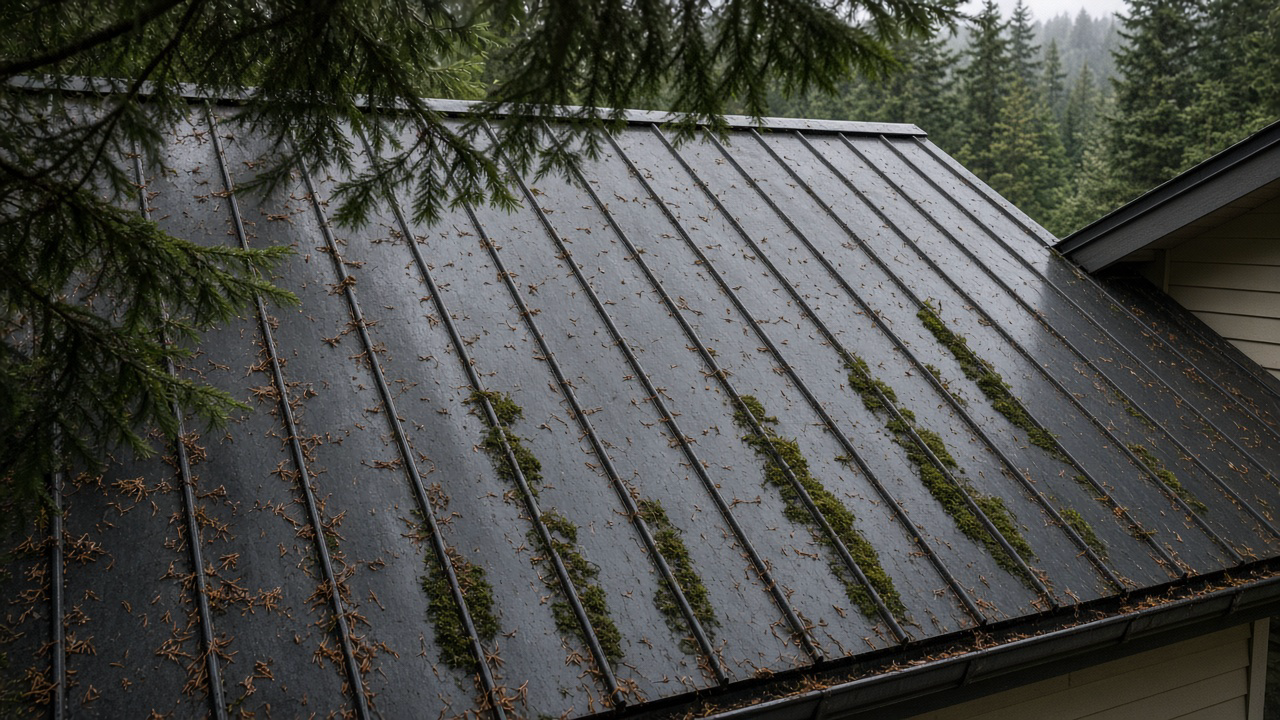
A metal roof is a smart choice on central Vancouver Island, but it is not a moss-proof roof. Under Douglas fir and western red cedar, standing-seam and ribbed panels in Nanaimo still collect green moss, dark algae streaks and needles. The open face of a panel can look clean from the street while the lower seams already hold a damp mat.
Growth on metal often starts as a dark film along a seam, a green line at the eave, or needles packed into a lap, around a vent, or just above the gutter. Nanaimo receives over 1,100mm of rain a year, and once those spots stay wet they stay wet. October is the window to deal with them before the heaviest Island rain locks the debris in place.
This guide covers why metal roofs grow moss and algae under Island trees, why that matters for fasteners, coatings, seams and gutters, what you can check from the ground, and why low-pressure soft washing is the gentler clean. Cleaning is not roof repair. Loose fasteners, failing sealant and rust need a qualified roofer, and the manufacturer's care notes still come first.
Why metal roofs still grow moss under fir and cedar
Metal sheds water faster than a shingle roof. It does not stay clean on its own. Moss and algae need moisture, shade and a place to hold organic debris. Lots under tall conifers supply all three, which is why metal roof moss removal in Nanaimo is a regular fall job, not an odd one.
Shade that never quite dries
Fir and cedar throw long shade across north pitches, lower planes and the wall side of a dormer. On a mild coastal fall, those panels can stay damp from one shower to the next. Algae does not need deep soil. Moisture and fine organic dust are enough for dark streaks on a painted finish.
Needles at seams, laps, vents and eaves
The face of a panel is slick. Debris stops where the roof is interrupted:
- Standing seams and ribs catch needles the wind walks downhill until they lodge in the joint.
- Panel laps on exposed-fastener roofs hold a thin mat where water slows.
- Around vents, pipes and skylight curbs needles pile the way they do in a valley, then stay wet against the flashing.
- At the eaves moss and needles sit just above the gutter and wash into the trough on the next hard rain.
Wet needles act like a sponge, and moss grows in that mat. Metal does not have to be porous. The debris is the soil. Shaded streets in Lantzville, Oceanside lots in Parksville and Qualicum Beach, and cedar-heavy properties toward Ladysmith show this every fall.
Why moss, algae and debris on metal matter
A green streak is easy to dismiss when the panel still looks solid from the driveway. The risk is what stays wet under the growth through November and December.
- Trapped moisture against fasteners. On screw-down metal, exposed fasteners and washers sit where needles pack. Coatings wear there, and a washer can start to fail.
- Coatings and seams stay damp. Painted finishes shed water. They are not meant to sit under a wet organic mat all winter. Algae and moss at laps hold moisture against the finish and along sealant.
- Clogged gutters. Needles, moss clumps and grit land in the eavestrough and can plug a downspout before the wettest weeks. Gutter cleaning with a full downspout flush belongs with metal roof work in fall.
- Slippery surfaces. Algae on a panel, a metal valley or the lower edge near a ladder is slick when wet. The same film shows up on decks and stairs under the drip line. Clearing the roof helps those edges. It is not a reason to climb wet metal.
A dark streak is not automatically a leak. Fall is still the time to remove the sponge before constant rain keeps it saturated.
Why pressure washing and scraping can damage the finish
Metal looks tough, so a pressure washer or a stiff scraper feels like the obvious tool. That approach is the one most likely to shorten the life of a painted roof.
- Painted finishes get dulled or cut. A close, aggressive fan marks factory paint on ribs and thin edges.
- Water is driven under laps and seams. Overlaps, sealant and closure strips shed water downhill. Blasting uphill or into a seam pushes water where the roof was meant to keep it out.
- Sealant and washers tear. Older gaskets get brittle. A scraper or a hard jet can nick them. A cut washer is a roofer's repair, not a cleaning detail.
- Panels scratch or dent. Walking a steep pitch, dragging a ladder across ribs, or scraping with metal leaves scars in the finish.
We do not use high pressure on roofs. Roof cleaning in Nanaimo is a soft-wash service for asphalt, cedar and metal, and the roof type is assessed before work starts. If the manufacturer's care sheet bans a cleaner or says to keep water out of the seams, that note wins.
Why low-pressure soft washing is the gentler approach
Soft washing uses low pressure and a solution that works on the growth, instead of blasting it off. Metal roof cleaning on Vancouver Island is that visit, not a driveway wash moved onto the panels.
Roof work uses eco-friendly biodegradable soft-wash solutions, with plants below in mind. The live site FAQ describes results on roofs in general: often a multi-year gap before heavy growth returns, and, when zinc strips are part of the package, most Nanaimo roofs staying moss-free for 3–5 years. That is the general FAQ, not a metal-roof promise. A north pitch under dense cedar regrows faster than an open south slope. Shade, needles and clear gutters all change the timeline. Why roof moss keeps coming back in Nanaimo covers the climate side.
What a careful metal roof clean includes
- Roof type first. Standing seam, exposed-fastener panels and older metal each need a slightly different touch.
- Debris lifted, not ground in. Needles and mats come off so the solution reaches the film, without scraping paint.
- A low, downhill rinse. Water follows the way the panels shed, rather than being driven into seams.
- Gutters in the same plan when troughs are full. Dead growth washes downhill. Leaving it in the trough undoes part of the job.
Zinc strips are a post-clean option on many roofs, including metal, when they can sit at the ridge. Rain carries a light zinc oxide film down the slopes and slows regrowth. Strips do not replace the clean or fix a leaking lap. The zinc strip guide explains that follow-up.
What you can safely do from the ground
A useful fall check does not need a ladder on metal. Wet panels are slippery, and a fall from a single-storey eave is still serious.
- Look up after rain. Note green at the seams, dark streaks on lower panels, and needle pillows at the eaves.
- Watch a normal rain at the gutter. Water sheeting over the edge, or a downspout that barely drips while the trough overflows, means roof debris is already winning.
- Clear only what you can reach without climbing. Blowing needles off a low porch roof from the ground is reasonable. Leave the pressure washer off the panels.
- Photograph trouble from the yard. Seams, vents, stained eaves and overflowing corners help size metal roof cleaning before anyone arrives.
- Keep the care notes handy. Some painted systems list cleaners to avoid. Mention rust, open seams or loose screws you can already see.
Skip mixes poured from a ladder. A strong bleach solution can stain siding, hurt plants and still leave growth in the needle mat. If the main roof is green, book moss removal instead of improvising.
When a roofer should take over
Soft washing removes biological growth and loose debris. It does not tighten screws, replace failed sealant, patch rust-through or reseat flashing. Call a qualified roofer, and pause cleaning on that spot, if you see loose or backed-out fasteners, cracked or missing washers, split or chalky sealant, rust that has pitted through, or panels that lift in the wind. Surface algae is a cleaning job. A fastener that no longer seals is not. Follow the manufacturer's care guidance, and say so if a repair is already booked so the wash can follow it.
How metal compares with asphalt shingles and cedar shake
All three roofs grow moss here. They hide debris in different places, and the wrong clean hurts them in different ways. Cedar has its own limits in moss on a cedar shake roof. The shared fall case is in fall roof cleaning before Island rains.
| Question | Metal | Asphalt shingle | Cedar shake |
|---|---|---|---|
| Where growth starts | Seams, laps, vents and eaves, often as streaks | Granule surface, valleys and shaded fields | Between shakes and on the weathered face |
| What holds debris | Needle mats in joints, not a porous face | Rough granules and any low spot | Gaps, checks in the wood, and shade |
| Why it matters | Damp on fasteners, coatings and seams; slick film; gutter load | Moisture held in the mat; granule wear if scraped | Wood stays wet; aggressive cleaning lifts fibres |
| High pressure or scraping | Can dull paint, nick sealant and drive water into laps | Strips granules and can shorten shingle life | Erodes the shake and opens the grain |
| Gentler approach | Low-pressure soft wash, following the maker's care notes | Low-pressure soft wash, never high pressure | Gentle soft wash that respects the wood |
Metal wins on shedding bulk water. It still needs clear seams and clear gutters.
Fall timing before the heaviest Island rain
Mid-October is a useful gap. Needles are dropping, moss is still reachable, and the longest rainy stretch has not settled in. If you wait until the troughs overflow, every seam stays wet while you hunt for a dry day. Central Vancouver Island does not offer many of those once November takes over.
- Roof growth first, with low-pressure soft washing matched to the panel type.
- Gutters and every downspout next, so needles and loosened moss do not sit in the trough.
- Another look from the ground after the next wind, because Island trees keep shedding past the first pass.
Branches over the eaves usually mean the debris has to come off, not just a rinse. There is no single schedule from Cedar to Qualicum Beach.
Book metal roof moss removal before the rains settle in
If the roof sits under Douglas fir or cedar and you can see green at the seams or dark streaks toward the eaves, this is the week to deal with it. Metal roof moss removal in Nanaimo, and metal roof cleaning across Vancouver Island, are soft-wash jobs. Pair them with gutter cleaning when the troughs catch the same needles. If a roofer is already booked for fasteners or sealant, cleaning should follow that repair.
On the quote form you can choose roof cleaning, moss removal, gutter cleaning or Multiple Services. Ground-level photos of seams, eaves, vents and any stained panels help us size the job before we arrive. We serve Nanaimo, Parksville, Lantzville, Ladysmith, Cedar, Qualicum Beach and surrounding central Vancouver Island communities, fully insured, with eco-friendly biodegradable soft-wash solutions on roof work.