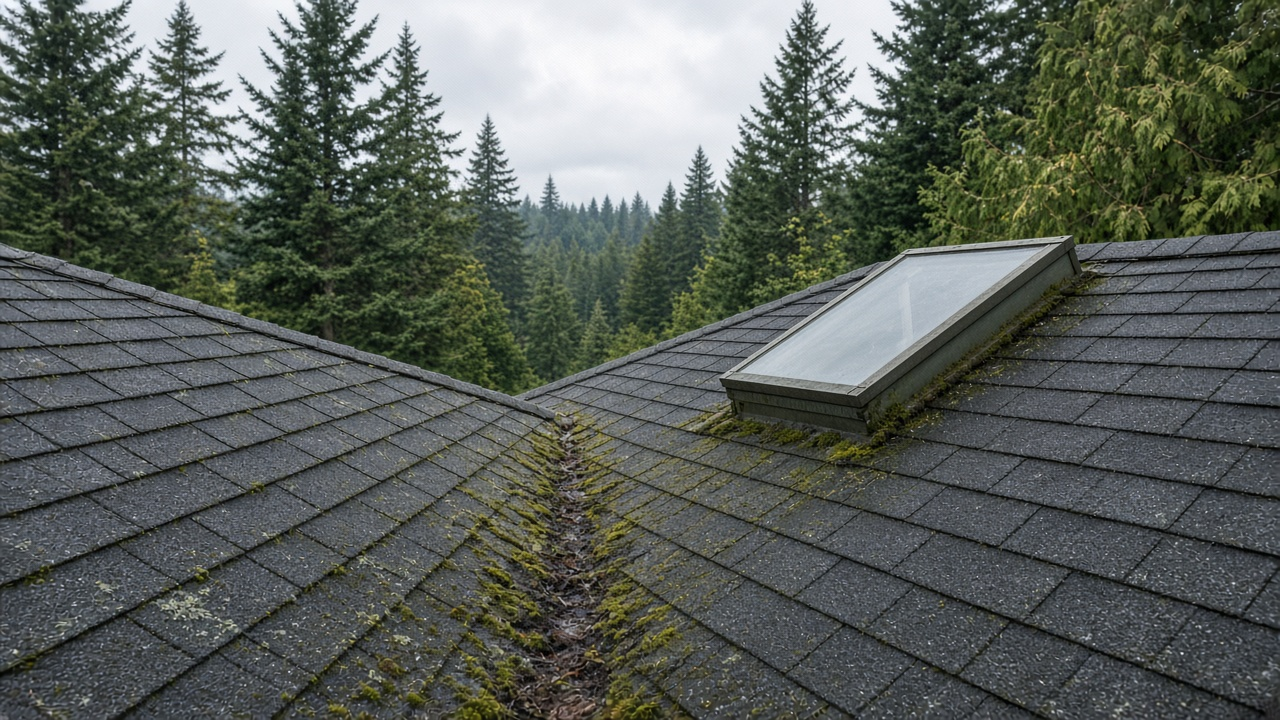
Walk past most Nanaimo homes in early fall and you'll notice the obvious moss: green patches on the open roof pitches. Those are easy to spot from the driveway. What usually isn't is the growth and sludge collecting where two roof slopes meet, around skylight curbs, behind dormers and at chimney junctions — damp pockets that stay wet long after the open shingles have dried.
On central Vancouver Island those micro-zones matter. Nanaimo gets over 1,100mm of rain a year, and shade from Douglas fir and cedar keeps valleys and skylight wells cool. Needles, lichen and organic debris settle there first, hold moisture against the roof, and give moss a head start before wet season digs in. If you've only been watching the open pitches, this is the corner worth a closer look.
Why valleys stay damp when the rest of the roof looks fine
A roof valley is the trough where two slopes join. Every rainstorm funnels water — and whatever was sitting on the shingles above — into that channel. On Island homes under tall trees, that means:
- Cedar and fir needles that pack into a mat
- Dead moss and lichen that washed off higher pitches
- Shingle grit and organic sludge that turns into a damp sponge
Once that layer builds up, the valley doesn't dry the way an open pitch does. Moss and algae thrive in the leftover moisture, and roots work into the shingles along seams where water is already concentrated. From the street, the main roof can look mostly clean while the valleys hold a wet season's worth of growth.
The same pattern shows up around dormer sidewalls, chimney flashing and vent stacks. Wind piles needles on the uphill side; rain keeps the pile wet; moss follows.
Skylight wells: small footprint, big moisture trap
Skylights create a built-in damp pocket. The curb that lifts the glass above the roof line forms a little well. Needles blow in, moss creeps up the curb, and lichen settles where flashing meets the shingles.
Homeowners often notice dull or spotted glass long before they notice growth at the base. The glass is a window washing job — interior and exterior panes, frames and sills — but the organic buildup on the curb and surrounding shingles is a roof moss problem. Treating only the glass leaves a damp collar that feeds dirt onto the skylight every time it rains.
North-facing or heavily shaded skylights start earlier and hold longer. Homes in Lantzville, Parksville and Qualicum Beach with big cedars overhead see this every fall.
What you're looking for from the ground
You don't need to climb onto a wet roof. A walk around the yard, a look from a second-storey window, or binoculars from the driveway is enough for a first pass.
Valley warning signs
- A dark line running down the valley that looks thicker or greener than the surrounding shingles
- Needles or twigs visible in the trough, especially after wind
- Water that sheets slowly or puddles briefly in the valley during rain instead of running clean
- Staining on the fascia or gutter under the valley outlet
Skylight and dormer warning signs
- Green or black growth climbing the curb or dormer sidewall
- Debris packed into the uphill corner where the curb meets the roof
- Damp streaks on the glass that return quickly after washing
- Soft or lifted flashing edges (if you can see them safely from below) — that's a roofer conversation, not a cleaning one
Chimney and junction warning signs
- Needles piled on the high side of the chimney
- Moss bridging from the roof onto the flashing
- Dark sludge where the roof meets the chimney base
Any of these before wet season is a cue to deal with the growth — not wait until January when everything is soaked and harder to access.
Soft wash reaches the roots — pressure doesn't belong on roofs
Scraping or blasting the open pitches and ignoring the valleys usually fails in two ways. High pressure on a roof strips granules and can force water under shingles. Scraping the tops of moss leaves the roots behind, so growth comes back fast — especially in damp pockets that never fully dried.
Our moss removal and roof cleaning work on asphalt, cedar, metal and tile uses a low-pressure soft wash. Biodegradable solutions reach moss, lichen and algae at the root instead of just knocking the green off. We never use high pressure on roofs. After roof moss removal, zinc strips at the ridge help slow regrowth as rain carries a light zinc oxide film down the slopes — including through the valleys that caused the trouble.
Soft-wash results on roofs typically last in the 2–5 year range depending on shade, moisture and tree cover. Island roofs under heavy fir and cedar still need ongoing attention; zinc and a clean valley stretch the gap between visits.
Cedar shake roofs hold moisture differently than asphalt. If your home has shakes, our guide to cedar shake roof moss cleaning covers why gentle technique matters even more on wood.
Gutters sit at the bottom of every valley
Whatever loosens in a valley or around a skylight — and whatever washes down in the next storm — ends up in the gutters. That's why a post-roof gutter flush is part of proper roof work, and why booking gutter cleaning alongside moss removal is usually smarter than treating them as separate seasons.
We clear debris by hand and with blowers, flush every downspout, and note anything damaged, sagging or missing. A valley packing needles all fall overloads its gutter section first. Clearing the roof pockets without clearing the troughs just moves the clog one storey down.
For the broader fall sequence, see fall moss removal and gutter prep and fall roof cleaning before the rains. For why growth returns after a scrape-off, why roof moss comes back covers shade, spores and damp.
Valley & skylight warning signs at a glance
| What you notice | What it usually means | Sensible next step |
|---|---|---|
| Dark green line in a roof valley | Needles + moss holding moisture in the trough | Soft-wash moss removal / roof cleaning |
| Needles packed uphill of a skylight curb | Debris trap feeding growth onto flashing and glass | Roof moss treatment; window wash for the glass |
| Moss climbing a dormer sidewall | Persistent damp where roof meets vertical wall | Soft wash the junction; check for lifted shingles |
| Sludge at chimney base | Junction stays wet; growth bridging to flashing | Roof clean + note flashing condition for a roofer if damaged |
| Staining under a valley outlet | Overflow or grit washing off a clogged valley | Roof + gutter clean with downspout flush |
| Skylight glass dull again days after a wipe | Dirt washing down from a mossy curb | Treat the curb/roof, then wash interior & exterior glass |
| Open pitches look OK but valleys don't | Classic Island pattern — micro-zones lag behind | Focus quote on valleys, penetrations and gutters |
When cleaning isn't enough
Soft washing removes organic growth. It does not fix a failing roof. If you see missing, cracked or lifted shingles, daylight through the deck, or an active leak around a skylight or chimney, call a roofing contractor first. Cleaning a compromised roof can make a leak worse. Once the roof is sound, moss removal protects the surface you just paid to keep.
The same rule applies to badly rusted or pulled flashing at a skylight curb — we clean around sound flashing; replacement is a roofer's job.
Timing it before the wet season locks in
October on the Island is when valleys and skylight wells tip from "a bit of green" into a packed, water-holding mat. Getting ahead of that shift means:
- Soft-wash the roof, with attention to valleys, dormers, skylight curbs and chimney junctions — not only the open pitches.
- Flush the gutters so dead moss and needles don't re-clog the system within weeks.
- Wash skylight and window glass after the roof work, so you're not cleaning grit that will wash down tomorrow.
- Ask about zinc strips if you want to slow the next cycle of growth.
We work year-round, rain or shine, so a damp forecast doesn't have to push the job into mid-winter. Homes across Nanaimo, Parksville, Lantzville, Ladysmith, Cedar, Qualicum Beach and North Nanaimo see the same valley-and-skylight pattern — the shade and rainfall don't stop at the city limit.
Get a clear look at your roof's trouble spots
If the open pitches look fine but the valleys, skylights or chimney junctions don't, say so when you request a quote. Photos from the ground help. On the form you can choose moss removal, roof cleaning, gutters, windows or Multiple Services, and we'll plan the visit around the micro-zones that need work — not a one-size scrape of the sunny side only.
Pricing depends on roof size and pitch, how heavy the growth is in those pockets, access, and which services you combine. A free quote is the straightforward way to get a number for your property.