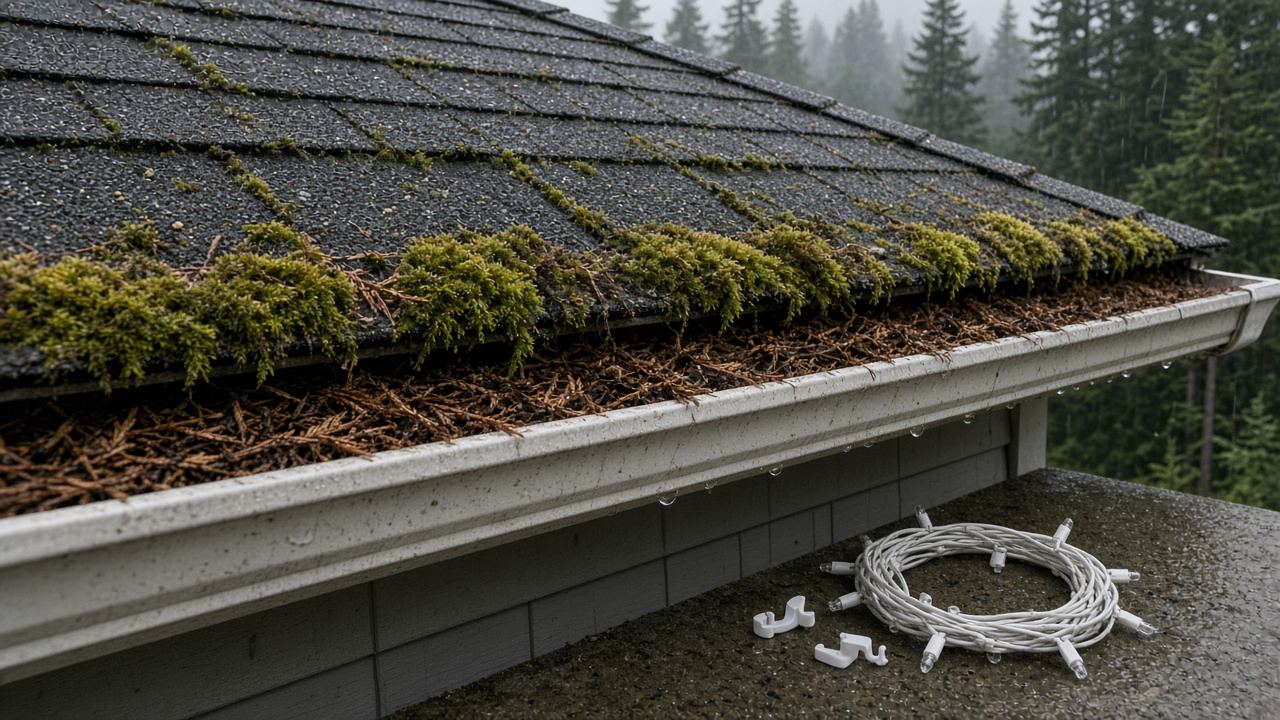
By the last week of October the light boxes come down off the shelf in Nanaimo, and the eave they belong on is often already in winter condition. The lower courses are green. Cedar scales and Douglas fir needles sit level with the gutter lip. The tab where a clip should slide is lifted, curled, or packed.
Put the string up after that edge is dealt with. A moss mat holds water, so the slope stays slick between Island rains. A clogged gutter spills onto the fascia, the bulbs and the ground under a ladder. A staple or a nail leaves a hole that January rain can follow. A plastic clip avoids the hole, and it still needs a tab that lies flat.
Stay off the slope while you decide. Nanaimo receives over 1,100mm of rain a year, and from here through November that rain comes in stacks. Clocks fall back on Sunday, November 1, the same weekend Halloween fills the front walk. Neither day is a good one to be at the eave.
Why the moss and the gutter come before the lights
The light line on most houses sits on the front edge of the roof, where shade, drip and debris meet. Under western red cedar and Douglas fir that band is usually the first to green up, on an open lot in Parksville or Qualicum Beach as much as under the trees in Lantzville, Cedar, Ladysmith and the rest of the Oceanside.
Moss holds water where a clip has to go
An open shingle sheds. A moss mat on the lower courses holds what the rest of the pitch has let go of, so the tabs stay damp and the leading edge curls. A clip is meant to hook that edge. If that edge is lifted or packed with growth, the clip will not seat, or it pries a cold tab into a crack. A first frost can brown the tips and still leave the mat, and cold asphalt bends less willingly. The timing guide for roof moss after the fall rains is about the whole slope. The courses you are about to clip should not wait for a spring visit.
A full gutter blocks the job, then the wet months
That trough is often full by now. Cedar and fir keep dropping, so a first fall clean often needs the second look. Clip a wire along the lip and the trough usually sits packed until the lights come down, through the wettest stretch, because lifting needles means unclipping the run. Overflow sheets over the fascia, soaks the socket on a string, and lands where a ladder would stand.
Gutter cleaning includes a full downspout flush. Cleaning is not gutter repair. A section that has pulled away, or fascia that is soft and stained through, needs a qualified contractor before it holds a clip or a staple. Clear the trough on the same visit as the roof. A soft wash does not vacuum moss off that day. Treated growth loosens later, and fragments wash into the gutter through November. A guard only hides the pack at the outlet.
Clips, staples and nails on the shingle
The lights come down in January. A hole in the shingle does not.
What a clip is asking of the tab
A plastic clip made for asphalt hooks the front of a tab and holds the wire without a puncture, when the tab lies flat. Moss, a curled corner, or lost granules get in the way, and forcing a clip can crack a cold tab. Do not seat clips in a green mat and treat the moss afterward. On a sound roof, moss removal and roof cleaning are a soft wash: eco-friendly biodegradable solution at low pressure, time to work, then a controlled rinse. High pressure strips granules and can drive water under the laps. Bald patches, or a fresh granule pile, go to a roofer before any clip. The granule guide sorts ordinary grit from a new pile.
What a staple or a nail leaves behind
A staple through the shingle, or a nail through a tab, leaves a hole that sheds water for the rest of an Island winter. A dab of sealant is not a new shingle. A nail in a cedar shake, or a screw through a metal panel, is the same shortcut on a roof that was not built to be punctured for one season. On sound metal, use a seam clip.
A staple in the fascia spares the shingle and still needs sound wood. Overflow-soaked boards are often soft, and the staple pulls out or splits them. The fascia, eaves and soffit guide is the ground check. Punky wood, a sag, or an open joint means stop. Cleaning will not replace that board or re-hang the gutter.
| What you use | What it usually does | When to leave it |
|---|---|---|
| Plastic shingle clip | Hooks a flat tab without a hole | Tab lifted, mossy, cracked, or cold and brittle |
| Staple or nail through the shingle | A puncture that outlasts the lights | Any course that still has to shed water |
| Staple into the fascia only | Spares the shingle if the wood is sound | Soft, split, or overflow-stained fascia |
| Nail in a shake, or a screw through metal | A lasting hole in a roof that was not a backer board | Any seasonal light line |
Why wet moss is a slip problem in November
Wet moss is slicker than wet asphalt alone. The mat holds water, so a north slope or a pitch under fir can stay greasy after the street has dried. November adds wind, overflow on the ladder feet, and short afternoons once the clocks change. Look with binoculars until the edge is ready and the morning is dry.
A foot in the gutter, a walk up to a ridge line the ladder will not reach, feet set in soil a downspout has been soaking: those are the ordinary slips. A gutter full of needles is not a step. If the display needs someone on the shingles, treat a sound roof first and still wait for a dry, mild break. Lights on a sound fascia, from a ladder on firm ground, never use the mat as a path. Pressure washing belongs on a driveway or a walk, not on shingles, and it will not make a roof safe to walk. Keep plugs out of the puddle under a spilling downspout.
When to treat the moss and clean the gutters
Decorating around Nanaimo usually runs through November, after Halloween and before the darker part of December. Book the cleaning into a weather gap. Hang lights on a later dry day.
- Look from the ground this week. Lower courses on the light side, the gutter lip, the downspout outlet, and the fascia.
- Separate a dirty eave from a failed one. Growth on sound shingles can be treated. Bald tabs, a ceiling stain, a split gutter or rotten fascia go to a qualified contractor first.
- Book the roof and the trough between systems. Pair a low-pressure wash with a gutter clear and a full downspout flush. Dying moss keeps shedding into the trough.
- Leave a gap before the string goes up. The day of the wash the roof is wet and the moss is still there. Growth loosens only with later weather.
- Skip the crowded days. Halloween is Saturday, October 31. Clocks fall back on Sunday, November 1. Remembrance Day is Wednesday, November 11. A dry weekday morning is the better ladder day.
A thin haze on an open south slope can sometimes wait until early spring. A matted eave, or a gutter that already spills, should not. Homes in Lantzville, Parksville, Ladysmith and Qualicum Beach follow that order. Trees change the thickness, not the sequence.
What to photograph from the yard
- The lower courses on the light side. A film, a mat, or tabs that curl off the course below.
- The gutter lip and one downspout outlet. Needles at the lip, or a tide mark on the fascia, means that run already spills.
- The fascia and the hangers. Soft wood, a pulled-away section, or a sag is a repair, not a clip.
- Bare shingles or a fresh granule pile at the downspout, for a roofer before any wash.
- What sits under the eave. Beds, a rain barrel, a path. Eco-friendly biodegradable solutions are standard, and runoff is planned around them.
A phone from the lawn is enough. Leave the ladder down until the morning is dry. If a cedar hides the street side, say so.
What a visit can clear, and what it will not hang
On a sound roof the work is a soft wash: low pressure, time for the solution, then a controlled rinse. Asphalt, cedar shake and metal are checked separately. Soft washing is that approach. We do not install holiday lights, seat clips, or staple wire. Have the edge ready before anyone else arrives to hang them.
Zinc strips go on the ridge after moss removal. The site FAQ says most Nanaimo roofs stay moss-free for 3–5 years with soft wash and those strips. Shade and a heavy cedar drop can shorten that. Strips do not empty a gutter or make a November roof safe to walk.
Gutters on that visit are a debris clear and a full downspout flush, with a note if a section sags or the fascia is done. Siding stains can wait for house washing until the trough stops feeding them. Glass at the eave is a window washing job once the grit is gone.
Questions from the driveway
Can I staple the lights for a month and seal the holes later? The hole stays in the shedding layer until that shingle is replaced. Use clips on flat, sound tabs, or keep the wire off the roof.
The gutter was cleaned in early October. Does it need another look? Often, yes, under cedar or fir. Needles refill a trough in a few weeks, and a light line holds that refill into the new year.
Can the lights go up the afternoon of the wash? No. The surface is wet, and treated moss stays put until later weather loosens it. Take another dry day, and stay off the slope.
What if the dry day comes late? Shrink the display. Keep lights off a mossy slope and off a gutter that spills.
Book the roof edge before you decorate
A mossy lower course and a packed gutter are what make November light-hanging hard on the house. See them from the yard this week, and book a soft wash plus a gutter flush on a sound roof while a weather gap is still open. Clip only after that gap, on tabs that lie flat, with nothing driven through the shingle. A leak inside, or rotten fascia, still goes to a qualified contractor first.
On the quote form you can choose Gutter Cleaning, Roof Cleaning & Moss Removal, House Washing / Soft Washing, Multiple Services, or Not Sure — Just Need a Quote. Ground-level photos of the eave where the lights will go, the gutter lip, the downspout outlet and the fascia help us size the job before we arrive. We serve Nanaimo, Parksville, Lantzville, Ladysmith, Cedar, Qualicum Beach and surrounding central Vancouver Island communities, fully insured, with eco-friendly biodegradable soft-wash solutions on roof work. House jobs start from residential services.