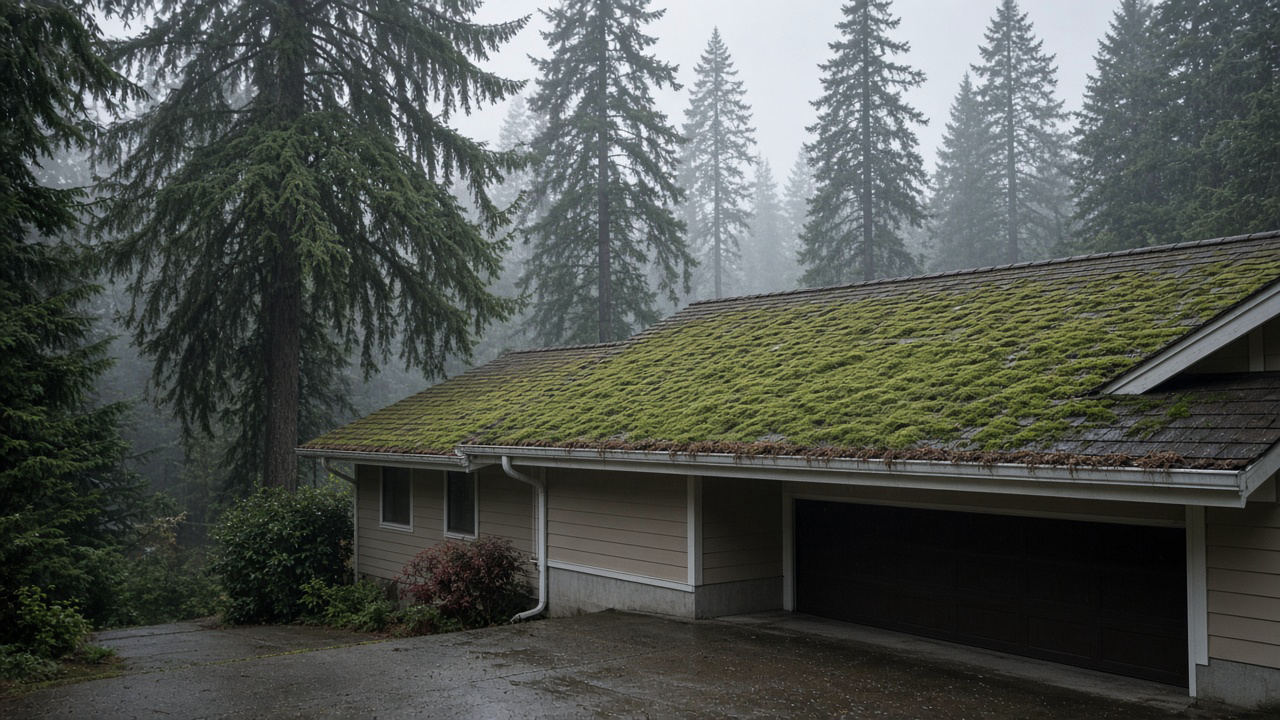
By the last week of October the fall rains are back on central Vancouver Island. A roof that looked like a faint green haze in September now looks thicker and darker. Much of that change is water sitting in moss that was already on the shingles. The mat holds the rain instead of letting the roof shed it.
This is the calendar for Nanaimo, Parksville, Lantzville, Ladysmith, Cedar, Qualicum Beach and the Oceanside, from here through early spring. The September window, treating before the rains, is mostly gone. Some weeks still left are good days on a sound roof. Others are only a look from the driveway.
Nanaimo receives over 1,100mm of rain a year, and the cool months are when roofs stay wet between systems. Clocks go back on November 1, so a roof day loses afternoon light as the systems stack up. Stay off the roof while you decide. Wet moss is slick. This is not the check after one heavy rain, and it is not why roof moss keeps coming back. It is when to book, when to wait on the weather, and when watching is enough.
Why the moss looks like it took off with the rain
Moss does not need one storm to colonize a Nanaimo roof. A thin film is usually already on the shady pitch, in the valleys, and under Douglas fir and western red cedar. A dry spell hides it. A wet October shows it, because the film stays damp and the colour deepens.
Rain does not rinse established moss off asphalt. It wets the mat. A thin film stays damp between systems where the fall sun never reaches. A thicker mat holds water after the open slope has shed. You cannot turn a wet afternoon into a growth rate. You can tell a haze from a carpet, and a carpet from a sheet that has started to lift.
What the rain changes on the roof
- Colour and bulk. Look on a dry afternoon as well as a wet one before you decide the roof changed in a week.
- How long it stays wet. Fir and cedar shade in Lantzville, Cedar, and parts of Ladysmith can keep a slope damp for days. Parksville and Qualicum Beach slow drying even with fewer trees.
- Where the water goes. Moss over the eave drips into the gutter with the cedar scales. The roof and the trough show up together.
The north and tree-shaded slope usually shows first. If that side is a carpet and the street face is clean, time the work off the bad pitch.
Late October and November are still a workable window
Late fall is not too late. It is pickier about the day. A soft wash puts eco-friendly biodegradable solution on at low pressure, leaves it time to work, and finishes with a controlled rinse. Book a break between systems, not a downpour.
The September note on soft-washing before the rains dig in was the earlier window. From the last week of October, book the gap you have. If the next stretch is heavy rain, wait for the next break. Do not book a visit the rain will wash off before the solution has time to act.
What a late-fall visit can still do
- Treat living growth on a sound roof. Dead moss loosens with later weather, so the gutters belong in the same plan.
- Match the method to the roof. Asphalt, cedar shake, and metal are not treated the same way. Roof cleaning and moss removal check the roof type first. High pressure is not used on roofs.
- Clear the troughs that catch what loosens. Gutter cleaning takes needles, moss, and grit out by hand and with blowers, and includes a full downspout flush. Cleaning is not gutter repair.
- Say what sits under the eave. Gardens, pets, and a rain barrel change the prep. Settle that when you book.
Zinc strips go on the ridge after roof moss removal. The site FAQ says most Nanaimo roofs stay moss-free for 3–5 years with soft wash and those strips. Shade changes that, which is why the moss-removal page also gives roofs a wider 2–5 year range. Strips do not clear a gutter or repair shingles. See zinc strips after moss removal.
What the treatment day needs from the weather
A dry week is rare from November on. Aim for a break.
- No heavy rain during the visit. The solution needs time before a controlled rinse. If a shower starts halfway through, pick another day.
- Morning damp can be fine. Water sheeting down the pitch is the problem. It carries solution off before it can act.
- Above freezing, with enough light. Ice is a day to move. After November 1, a two-storey house under trees is a morning job.
- A ladder spot that is not flooded. Do not climb a wet mossy roof to get ahead of the next system.
If this week does not qualify, you have missed a day, not the year. Soft washing on the siding under the eave waits on the same kind of day.
Winter is for the gaps, not for forcing a visit
December through February is short days and roofs that rarely dry all the way. Moss removal does not stop on a date. You stop treating every week as a treatment week.
A gap worth taking
A break with no heavy rain during the work, air above freezing, and safe access is still a workable day. Use it when a thick mat has slid toward the eave, or when the gutters overflow in ordinary rain. A mat in the trough is roof and gutter together. A pulled hanger or rotten fascia needs a contractor first.
When winter is only for monitoring
- A thin film on a sound roof. Photograph each slope from the ground and wait for a better gap, or for early spring.
- Ice, a wind warning, or water already inside. Cleaning is not roof repair. Missing shingles or a new ceiling stain is a roofer's job first.
- The worry is the front walk. A busy week at the end of October does not change the roof. A slick path is not a reason to scrape shingles between showers.
Early spring is the second window
March and April are the other opening. Days lengthen, and the shady pitch can be thicker than it was in October because it stayed damp. Spring is later, not better.
Book it when fall and winter never gave you a safe day, or when fall growth was only a film. It is a weak plan if the mat was already a carpet in October and the gutters overflowed in November.
What to look for when the days lengthen
- Compare the shady pitch with your fall photos. Thicker, lifted, or hanging over the gutter means the winter fed it.
- Check the troughs first. Douglas fir and western red cedar keep shedding. Packed gutters will catch whatever a roof visit loosens.
- Look at grit by the downspout. A light scatter on an older roof can be ordinary wear. A fresh pile and bald patches are a reason for a roofer to look before any wash.
- Then book a break, as you would have in November. A March storm is not a better treatment day because the calendar says spring.
Book, wait, or just monitor
Decide from the ground. You do not need to get on the roof to choose.
| What you see from the ground | Where it sits on the calendar | Sensible next step |
|---|---|---|
| Thin green film, gutters still flowing | A late-fall or winter gap, or early spring | Photograph it. Book a soft wash when a break lines up |
| Patchy carpet on the shaded slope, needles in the trough | Late fall is still worth doing | Soft wash on a sound roof, plus a gutter clear and downspout flush |
| Thick mat in the gutter, overflow in ordinary rain | The next safe gap, including winter | Roof and gutters together. Do not hold a carpet for April |
| Growth only in one valley or along one eave | Any workable day from now through spring | Say so on the quote so the visit matches that area |
| Missing shingles, a ceiling stain, or a gutter off the fascia | Not a cleaning week | A roofer or gutter contractor first. Cleaning is not a repair |
| Only a haze, and the next stretch is solid rain | Monitor until a break | Ground photos. Book the first workable day, or early spring |
A slick path is a pressure washing job and does not change the roof plan. Green siding is house washing or soft washing after the roof and gutters. Glass can wait for window washing. The same rain falls from Ladysmith and Cedar through Lantzville, Parksville and Qualicum Beach.
What to expect, and when a roofer comes first
Send ground-level photos of each slope, the gutter lip, and any downspout that misbehaves. Name the side of the house. Note the trees, a rain barrel, pets, and whether the roof is asphalt, cedar shake, or metal. Say if the gutters are the same visit.
On a sound roof
The visit is a soft wash: low pressure, eco-friendly biodegradable solutions, time to work, and a controlled rinse. Zinc strips go on the ridge afterward. A gutter clear the same day includes a full downspout flush. Treated moss loosens with later weather. It does not disappear before the crew leaves.
Call a qualified contractor before a wash
- Shingles are missing, cracked, or bald, or water is already inside. A wash does not replace a roof.
- The gutter is hanging or pulling the fascia. Cleaning is not gutter repair.
- A limb is on the roof or hung in a cedar. An arborist moves wood.
- The only access is a ladder in standing water. Send the photos and let the day move.
Questions once the rains are back
Is it too late in the year? Not on a sound roof, if the day gives the solution time to work. Early spring is the backup when no gap opens.
Will it look finished the same afternoon? No. Treated moss sheds later, which is why the gutters are part of the visit.
Book the gap that matches the roof
Once the fall rains return, roof moss on a Nanaimo house holds water and shows itself. Late fall still works when a break lines up with a sound roof. Winter is for the safe gaps, and for watching the rest. Early spring is the second window. A thin film can wait. A carpet already feeding the gutters should not sit until April if a workable day comes sooner.
On the quote form you can choose Gutter Cleaning, Roof Cleaning & Moss Removal, House Washing / Soft Washing, Multiple Services, or Not Sure — Just Need a Quote. Ground-level photos of each slope, the worst gutter corner, and any granule scatter help us size the job before we arrive. We serve Nanaimo, Parksville, Lantzville, Ladysmith, Cedar, Qualicum Beach and surrounding central Vancouver Island communities, fully insured, with eco-friendly biodegradable soft-wash solutions on roof work. House jobs start from residential services.