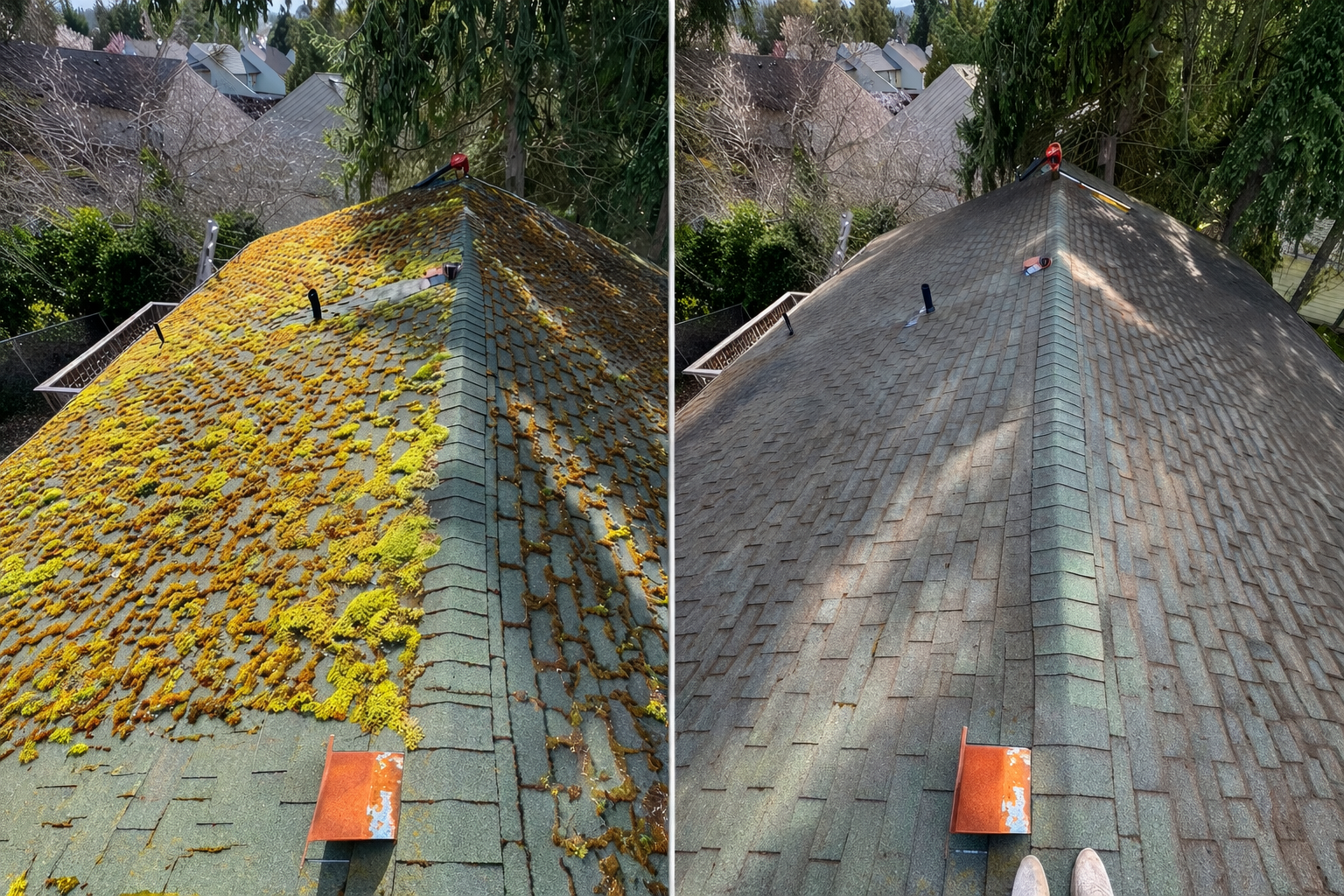
If you've ever looked up at a green roof in Nanaimo and thought "I need that gone," the very next thought is usually about what's underneath it. The hydrangeas along the foundation. The vegetable bed by the downspout. The dog who treats the side yard as their personal office. Maybe a rain barrel you fill all winter for the garden.
It's a fair question, and it's one we hear on almost every moss quote from Cedar to Qualicum Beach. Here's a straight answer about what a professional moss treatment involves, what's actually at risk around your yard, and the simple prep that makes treatment day uneventful for your plants and pets.
Why moss treatment worries homeowners (and why that's reasonable)
Most people's mental picture of moss removal comes from one of two places: a neighbour on a ladder with a pressure washer, or a jug of store-bought moss killer poured straight onto the roof. Both leave a mess. Pressure washing blasts chunks of wet moss and grit onto everything below and can damage the roof itself. Over-the-counter products applied heavy-handed tend to end up exactly where you didn't want them: on the lawn edge, the shrubs and the patio.
So when you hear "chemical treatment," it's natural to imagine the worst. The reality of a careful soft wash looks quite different.
What a soft wash moss treatment actually is
At Moss Bros, roofs are never pressure washed. We use soft washing: low-pressure water combined with biodegradable, moss-killing solutions that soak into the growth and kill it at the root, instead of tearing the surface apart. You can read the full comparison in our guide to soft washing vs pressure washing.
Two things about that approach matter for your yard:
- Low pressure means less flying debris. The solution is applied at roughly garden-hose pressure, so you don't get the spray cloud and shrapnel of moss that a pressure wand throws across beds and decks.
- Biodegradable solutions are chosen with surroundings in mind. The products we use are biodegradable and eco-friendly, and they're safe for pets and family once dry.
That doesn't mean "spray anything anywhere." It means the method is designed to be used carefully around the places people actually live, and the rest comes down to how the job is run.
How plants and landscaping are protected
The main thing that reaches your garden isn't the treatment itself so much as runoff: rinse water and dead growth moving down the roof, into the gutters and out the downspouts. That's where most of the care goes.
Every property is different, but careful landscaping protection on a central Island home generally comes down to a few things:
- Looking at what's below before anything is applied. Foundation beds, hedges, potted plants on the deck and anything growing right under a downspout all get noted.
- Controlling where water goes. Treating in sections and managing the downspout outlets keeps runoff from pooling around one plant bed.
- Starting with well-watered plants. Plants that are already hydrated take up far less of whatever lands on their leaves, which is why watering your beds the day before is on the checklist below.
- Planning for the gutters. When moss dies and loosens, it heads straight for your eavestroughs. That's why we recommend pairing a roof treatment with a gutter cleaning flush, so dead growth doesn't sit in the troughs or back up over your beds in the next storm.
We take precautions to protect plants and landscaping around the treated area on every job, and the same goes for house washing, where siding runoff lands right at the base of your foundation plantings.
Pets: what to do on treatment day
The simple rule: keep pets inside or away from the work area until treated surfaces are dry. Once dry, the solutions are safe for pets and family.
A few practical notes for Island pet owners:
- Bring dogs and cats in before the crew starts, and keep them in until the outside surfaces have dried. If you're not sure, just ask the crew before you open the door.
- Move water and food bowls, pet beds and toys off decks and patios near the house.
- If your dog loves to drink from puddles or chew on fallen moss, give the yard a quick look before letting them back out, especially along the drip line under the eaves.
- Backyard chickens? Mention them when you book so we can plan around the coop and run.
None of this is complicated. It's the same common sense you'd use when anyone is working on your roof.
Rain barrels, wells and ponds: mention them at quote time
This is the one area where your setup really changes the plan, and it's surprisingly common on the Island. Plenty of homes in Cedar, Errington, Coombs and the rural edges of Nanaimo collect roof water in barrels or cisterns, and some properties rely on wells or have a garden pond or water feature fed by a downspout.
If water from your roof goes anywhere other than a drain, tell us when you request your quote. In practice, that usually means:
- Disconnecting or diverting downspouts that feed a rain barrel or cistern before treatment and through the rinse, so treatment runoff and dead moss don't end up in water you'll use later.
- Planning around ponds and water features so roof runoff isn't channelled straight into them.
- Talking through zinc strips. We install zinc strips at the ridge after roof moss removal to slow regrowth. If you collect roof water or have a pond fed by the roof, it's worth discussing whether they suit your setup.
Getting these details up front is what keeps treatment day simple. It's much easier to divert a barrel the morning of the job than to wonder about it afterwards.
A quick prep checklist before your moss treatment
Run through this list the day before, and you'll have done most of the work of protecting your yard:
| Before treatment day | Why it helps |
|---|---|
| Water foundation beds and potted plants well | Hydrated plants take up far less of anything that lands on them |
| Move pots, furniture, cushions and pet gear away from the house | Keeps them clear of the drip line and rinse water |
| Disconnect or divert downspouts to rain barrels | Keeps runoff and dead moss out of stored water |
| Close windows and vents near the roofline | Keeps rinse mist outside |
| Plan for pets to stay indoors | They come back out once surfaces are dry |
| Note ponds, wells, cisterns or chickens on your quote request | Lets us plan runoff and timing around them |
| Unlock side gates | Lets the crew reach every downspout and bed without detours |
Fall is the right time to ask these questions
October on central Vancouver Island is when moss wakes up for the season. The rains return, shady roof slopes under firs and cedars stay damp for days, and growth that looked like a faint green haze in August starts to thicken. Treating now, before the heavy winter fronts, means dead moss can loosen and clear through the season instead of soaking up water on your roof all winter. If moss keeps returning on the same slopes, our post on why roof moss comes back explains the shade-and-moisture pattern behind it, and if you have a wood roof, see moss on a cedar shake roof.
Fall is also when gardens are winding down. Perennials are cut back, annual beds are mostly done and lawns are slowing, which makes it an easy season to plan treatment around your landscaping.
Common questions from Island homeowners
Will moss treatment kill my grass or shrubs? A careful soft wash is designed to treat the roof, not your yard. We take precautions to protect plants and landscaping around the treated area, and the prep steps above (watering beds and managing runoff) do most of the rest.
How soon can my dog go back outside? Once the treated surfaces are dry. Keep pets inside until then, and check with the crew if you're unsure.
Can I keep using my rain barrel? Tell us about it when you book. Plan to divert or disconnect the downspout feeding it before treatment and through the rinse, and talk with us about when to reconnect it and whether zinc strips make sense for your setup.
Is soft washing safer for my roof than pressure washing? Yes. Pressure washing can strip granules and damage roofing, which is why we never use high pressure on roofs. Soft washing kills moss at the root at low pressure. Learn more on our roof cleaning page.
Do you treat moss outside Nanaimo? Yes. We provide moss removal across central Vancouver Island, including Parksville, Lantzville, Ladysmith, Cedar, Qualicum Beach and North Nanaimo.
Get your roof moss-free without worrying about the yard
If you've been putting off moss removal because of the garden, the dog or the rain barrel, you don't have to choose between a clean roof and a healthy yard. Tell us what's below the roofline, and we'll plan the treatment around it.
See how we handle moss removal in Nanaimo and soft washing, or skip straight to the quote.