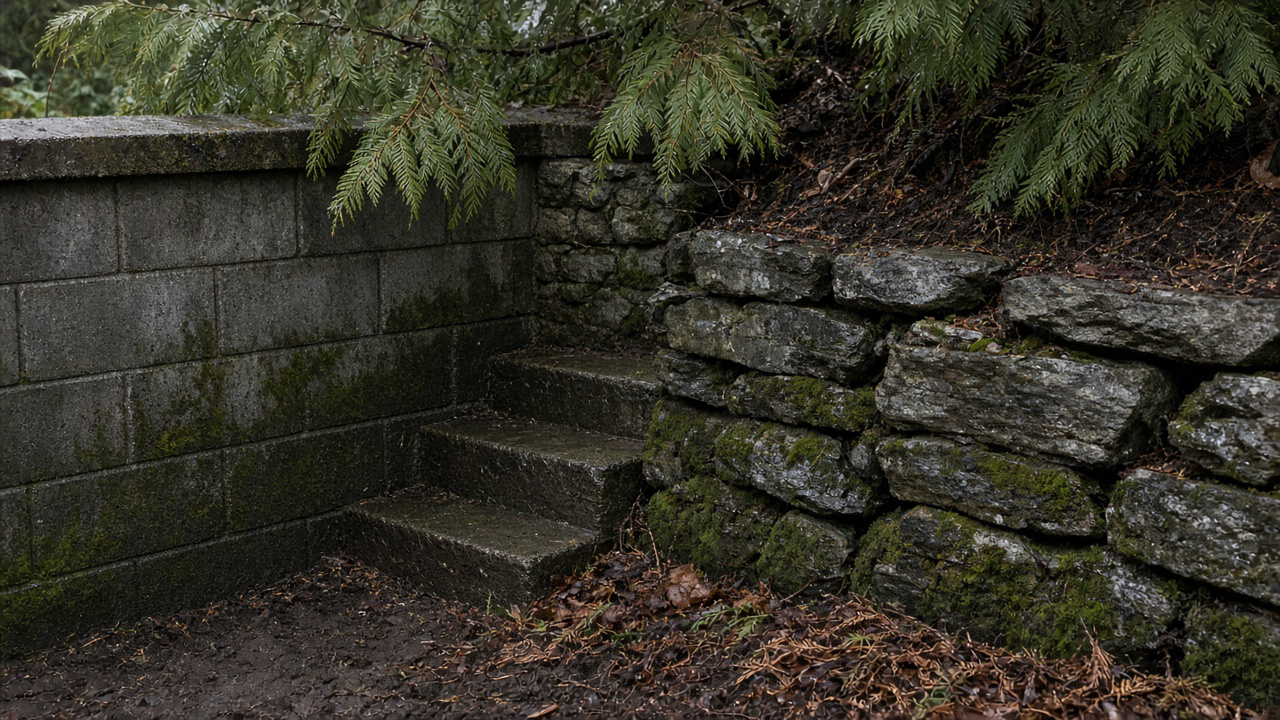
Clocks fell back on Sunday, November 1. By mid-afternoon a Nanaimo backyard wall is already in shade, and the concrete has not dried since the last shower. The face that looked grey in September now shows a green band at the base and a dark film in the joints.
Steady rain does not rinse that wall clean. It keeps moss in the mortar and a thin algae film on the flat, and it wets the needles piled along the footing. Nanaimo receives over 1,100mm of rain a year. Early November is when short days and back-to-back systems stop a shaded wall from drying. A line that looked cosmetic in September is a soft edge by Remembrance Day on Wednesday, November 11, which is when guests use the path beside it.
This post stays on retaining walls: poured concrete, concrete block, stacked stone, and the steps built into that wall. A wood privacy fence is the fence-line guide. A flat driveway or patio is the driveway and patio guide. Wood decks and outdoor stairs are the deck and stairs guide. Roofs, gutters, and glass are separate jobs.
Why the face stays green once November sets in
A September afternoon still gives a south-facing wall hours of light. After the clocks change, that same wall is in shade by mid-afternoon, and a north face under western red cedar may not see sun at all.
Rain wets a dark film, splash from the path polishes the lower courses, and the next system arrives before the face dries. Douglas fir needles and cedar scales at the footing hold that damp.
Shade and the drip line do more than the forecast
A wall under a deck, a carport, or a fir that reaches the cap stays wet longer than the open face beside the lawn. North Nanaimo and Lantzville often have that canopy over the back lot. Parksville and Qualicum Beach add Oceanside damp that never quite leaves a shaded run. Ladysmith and Cedar see the same green joints on a garden wall that misses a dry day.
A downspout or a roof edge that dumps onto the cap feeds one stripe. The water above it is why that stripe returns after every system.
Where to look before you book
You do not need to stand on the wall. A wet cap is a poor step. After a shower, walk the path a guest would use and look at the face, the joint, and the base.
The face, the joint, and the footing
Moss sits in the mortar where one stone meets the next. The film on flat concrete is easy to miss until the lower courses look painted green. Needles against the footing keep the first course damp after the cap has shed. A slick band only under a drip or a downspout means the wall is being fed. If that water comes from a packed gutter, gutter cleaning with a full downspout flush belongs with the wall.
Caps, weeps, and the steps in the wall
Moss on a concrete cap holds water against the joint under it. A wood cap is a different surface, and a close jet that is fine on sound concrete can raise the grain on that board. Weep holes let water behind the wall leave. Needles over those openings are a cleaning problem. A bow, a lean, or a fresh crack through several courses is not. Cleaning does not rebuild a wall.
- Needles over the weeps. A broom moves the loose layer. It should not pack debris into an opening.
- A step worse than the open face. Guests use the change in level. A slick nosing outranks a tidy field of block.
- A shifted cap, or a course that has stepped out. That is a mason or a landscape contractor. A wash does not reset the stone.
Concrete, block, and stone are not the same wash
One yard often has more than one of these on the same afternoon. Soft washing versus pressure washing is the wider method note. On a retaining wall the surface decides which one leads.
| What you see from the path | What it usually means | Sensible next step |
|---|---|---|
| Dark film on sound poured concrete or concrete block | Algae on a face that no longer dries | Soft-wash the growth, then pressure-wash where the concrete is sound |
| Moss in the joints of stacked stone or brick | Growth in the mortar and the recess, fed by shade and needles | Treat, then a controlled rinse. Do not blow the mortar out |
| Soft stone, a crumbling joint, or a painted block face | The surface cannot take a close jet | Soft wash only. High pressure etches stone and scars paint |
| A green stripe only under a downspout or roof edge | The wall is being soaked from above | Open the gutter and downspout, then wash that run |
| A bowed face, a shifted cap, or a crack through several courses | A repair, with film on top of it | A qualified contractor before a wash will hold |
| Green splash on the siding above the cap | Overflow or roof growth landing on the wall and the house | Clear the water path, wash the wall, then wash the siding |
A white chalky bloom on newer concrete is often mineral salt, not algae. A biology wash is for the green film. It may lighten a white bloom and still leave it.
What a careful clean looks like
Early November still has mild gaps between systems. Rain mid-visit rinses a treatment off before it has worked, so a useful day has to leave time for the solution to sit, then a rinse.
Treat the growth, then rinse where the surface can take it
Soft washing puts an eco-friendly biodegradable solution on the growth at low pressure and leaves time for it to work. That is the right start on moss and algae, including stacked stone and any face that should not take a close jet. If the next system is an hour away, the solution leaves with the rain. Book the gap.
Pressure washing belongs on sound concrete, concrete block, brick, and durable stone after the film has been treated. A blast on its own can stripe the face, carve a soft joint, and leave growth in the pores. It is the wrong tool for crumbling mortar, soft sandstone, painted block, or a wood cap.
A sensible order when the wall is being fed
- The water path first. If a gutter dumps onto the cap, flush that downspout before the wall is the finished surface.
- Roof growth next, if it sheds onto the cap. On a sound roof, moss removal and roof cleaning come before the wall will stay clean. Failing shingles go to a roofer.
- Loose debris off the cap, the steps, and the footing, without packing needles into a weep or prying a loose stone.
- The wall face, solution where the growth is living, then pressure only where the concrete or stone can take it.
- The siding last. House washing waits until splash from the cap has stopped, the same order as a fall house wash.
What a wash will not fix
A clean face is easier to live beside. It is not a repair, and it is not a promise that a step will never be slick.
A failing wall stays a failing wall
A bow, a lean, a cap that rocks, a course that has stepped out, and a crack through the face are contractor work. If the cap already moves under your hand, book the repair first.
A buried weep, or a drain that has never worked, is a question for a qualified contractor. Clearing needles off an open weep is cleaning. Digging out a failed drain is not. Cleaning is not retaining-wall repair.
Film is only one reason a step is slick
Rain on smooth concrete is still wet concrete. Leaves, a needle mat, and ice on a clear night remain after the algae is gone. A wash does not install a non-slip coating. Growth under cedar comes back. November is a reset before the dark wet stretch, not a bare wall until spring.
Keeping the path usable while the wall is wet
The face has to be wet to be cleaned. Remembrance Day week is a poor time to find the only route to the door is the one under the hose.
- The path guests use. Where the yard has two ways through, wash one run while the other stays dry.
- Name the water. Which outdoor bib the crew may use, and where the rinse may run: a storm drain, a bed you are willing to wet, or a lower path. A pond and a rain barrel at the base belong on that note.
- The run that is being fed. If a downspout soaks the same courses every storm, the gutter belongs on the same visit.
- Strata walls and common paths. A garden wall along a visitor walk is still this surface. The slick walking route itself is the November walks guide. Commercial services covers a common wall when the booking is the building, not the house.
Note a locked side yard, and say whether this is one November gap or a wider clean.
Questions from the path
Will November rain wash the wall clean? Rain moves loose needles and wets the film. A face that looked dusty in September can be green in the joints by the second week of the month.
Can a close jet replace a treatment? On sound concrete, pressure lifts dirt after the growth has been treated. On its own it can stripe the face and leave roots in the joint. Soft stone, painted block, and a wood cap take soft washing.
Does a clean wall mean the steps are safe? It removes moss and algae that make a wet step worse. Smooth concrete, rain, ice, and a needle mat can still be slick. Cleaning is not a coating, not a repair, and not a guarantee.
The fence was done in October. Why is the wall still green? A fence wash stays on the boards. The concrete or stone below it is a different surface, and November has added shade and splash since that visit.
Book the wall before winter locks the green in
After the next shower, look at the run beside the path. Green joints, a dark film on the lower courses, or a step that stays wet is the November problem on a concrete or stone retaining wall. Book that face while a mild gap still exists. A bow, a shifted cap, or a crack through the courses goes to a contractor first. Cleaning is not that repair.
On the quote form you can choose Roof Cleaning & Moss Removal, Gutter Cleaning, House Washing / Soft Washing, Window Washing, Pressure Washing, Commercial Services, Multiple Services, or Not Sure — Just Need a Quote. Ground-level photos of the wall face, the joints, the cap, the steps, the footing, and any downspout that feeds them help us size the job before we arrive. Note whether the wall is concrete, block, or stone, and whether a plant bed, a pond, or a rain barrel sits at the base. We serve Nanaimo, Parksville, Lantzville, Ladysmith, Cedar, Qualicum Beach and surrounding central Vancouver Island communities, fully insured, with eco-friendly biodegradable soft-wash solutions where the growth needs treatment before a rinse. House jobs start from residential services.