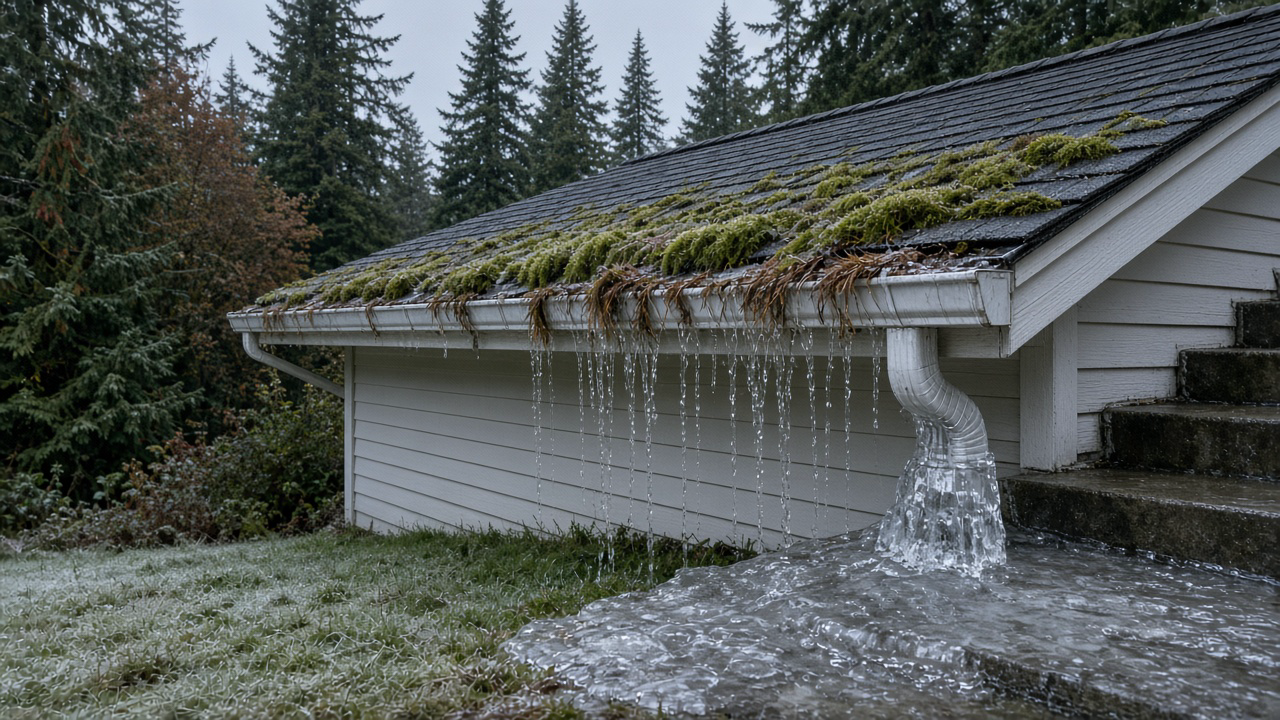
Saturday, November 14, and the week has turned. The gutters are still full of Douglas fir needles and cedar scales, and the moss on the shaded eave is still wet. Overnight temperatures are dropping toward freezing. A clear stretch after a soaking day is enough to put ice where that water has been sitting.
Early fall was the time to empty a trough before the rains settled. Mid-November is the week those rains have kept the debris wet. Nanaimo receives over 1,100mm of rain a year, and a north eave under western red cedar does not dry between systems. The water only needs to be there when the air drops.
This post stays on that cold: packed needles, a clogged gutter, wet moss, and the ice the overflow makes on the walk, the steps, and at the downspout. What a frost does to the shingles is the first-frost roof guide. Needles still packing the trough are the November needle guide. A pipe that backs up in ordinary rain is the downspout guide. Green film on the treads is the front steps guide. Cleaning is not ice control, and it is not gutter repair.
Why a night near freezing changes a packed gutter
A bare trough sheds a shower, and the walk stays where the downspout aimed it. A trough packed with needles holds the water until it goes over the front lip. On a mild night that sheet is a puddle. On a night that reaches freezing it is a skim of ice at dawn, clear enough that the walk still looks only wet.
Shade that never dried
North Nanaimo and Lantzville often have Douglas fir or western red cedar over the eave, so the trough and the walk under it miss a dry afternoon. Parksville and Qualicum Beach add Oceanside damp. Ladysmith and homes in Cedar see the same dark lip where a side gutter misses the low November sun. The run under the trees is the one that ices. Remembrance Day was Wednesday, November 11, and early holiday visits are already on that path after dark.
A thin freeze, not an ice dam
This is not an interior week of deep cold, and it is not ice packed under the shingles. A Nanaimo cold snap is often one or two clear nights between systems. The ice is a skin on overflow, plus water the moss is holding at the eave. Open the path before that night. The square that ices is the one the gutter has been feeding.
Where a full trough sends the water
Needles and cedar scales mat when they are wet, and the next drop sits on top. Moss over the lip joins that mat. The outlet closes first. Water then leaves at the low point: the front lip above the walk, or the corner above the steps.
What you can read from the yard
Stay on the ground. A ladder on a frosted morning is the wrong tool, and a wet mossy eave does not grip. A dark rope along the lip, a wet fascia below a dry downspout, or a sheet off the front edge in a shower means the outlet is not taking the rain. Cedar scales pack tighter than fir needles. A guard on the trough does not mean the elbow is open.
- A sheet over the front lip. The trough or the outlet is packed. That sheet is tomorrow's ice if the night drops.
- A dry downspout under a wet fascia. Water is leaving somewhere other than the pipe.
- A dark band under one corner. That corner is being fed. The rest of the walk can look ordinary.
- Moss over the lip. The roof is adding to the dam. Roof and gutter belong together on sound shingles.
- An extension aimed at the steps. The pipe may be open and still dumping on the tread.
Ice at the downspout, and a roof you do not test
A downspout that is only partly open can still make ice where water pools at the shoe. A blocked pipe sends that water over the lip instead. Flush either one on a thaw.
The shoe and the pad
The elbow just above the ground is where needles stop. A white skin on the pad at dawn, with the lawn only frosted, means that outlet dripped all evening. Leave the ice. Do not kick the shoe, and do not pour hot water up the pipe. A cold fitting and a sudden heat are how a joint lets go.
Say so before anyone rinses if the shoe sits in a plant bed, a pond, or beside a rain barrel. A strata walk or a shop entry on the same overflow is commercial services. A manager can start from the commercial quote.
Wet moss stays off limits
The same night films the moss. The green can look unchanged, and a boot will not grip. Stay off the slope. What a freeze does to the tab is the first-frost guide above.
On a sound asphalt roof, moss removal and roof cleaning are a soft wash: an eco-friendly biodegradable solution at low pressure, then a controlled rinse. Pressure washing stays on sound concrete once it is not iced. Soft washing is the roof approach. High pressure strips granules. The site FAQ says most Nanaimo roofs stay moss-free for 3-5 years with soft wash and ridge zinc strips. Strips do not open a gutter, and that span is not about ice on the walk.
Overflow, ice, and a failed gutter are not the same job
A close jet that suits a sound pad can drive water behind a loose joint or tear granules off a cold shingle. A packed run and a rotten fascia are not the same booking.
| What you see from the yard | What it usually means | Sensible next step |
|---|---|---|
| A sheet over the lip, needles visible, fascia still sound | A packed trough or outlet, so rain leaves at the front | A full downspout flush before the next clear night |
| A white skin at the shoe, the lawn only frosted | A dripping outlet that froze on the pad | Leave the ice. Flush the pipe on a thaw |
| A clear skim on a green walk or the bottom step | Overflow sitting on algae | Open the gutter, then wash sound concrete |
| Thick wet moss at the eave, tabs still flat | A mat feeding the trough | Soft wash in a mild gap. Do not scrape |
| A sagging trough, a split joint, or soft fascia | A repair under the debris and ice | A qualified contractor before a clean on that run |
Gutter cleaning takes the needles, scales, and moss out of a sound trough and includes a full downspout flush, so the water is off the eave before the next night drops. If the mat is feeding the trough, do the roof and the gutter together. House washing on the stained wall comes after the lip stops spilling. Glass under that drip is a window washing job once the grit stops washing down.
What to clear before the first frost
Mid-November still has mild gaps between systems. Rain mid-visit rinses a treatment before it has worked, and dawn frost means the eave and the pad may be icy first thing. Book the gap. Leave the ice.
- The trough first. Lift needles, cedar scales, and moss out of a sound gutter. A hose on a mat only moves the dam.
- The outlet and the aim. A full downspout flush, then point a slipped extension off the steps and the walk.
- Sound shingles, if the mat feeds the gutter. Soft wash in that gap, not on a frosted morning. Cracked tabs or a ceiling stain go to a roofer.
- The splash, once it is not iced. Wash sound concrete. A heaved slab or a soft board is not a wash.
- The wall and the glass last. Stained siding and spotted panes wait until the trough is open.
Name a plant bed, a pond, or a rain barrel under the drip, and move a bin if it sits in the splash. A second-storey eave is a ladder on wet ground. Leave that to the crew.
What a clean will not fix
A cleared trough sends water to the downspout it was built for. A treated mat stops holding a sponge against the eave. That is the cleaning. It will not reseat a hanger, close a split joint, replace rotten fascia, or put a cracked tab back. A gutter pitched the wrong way can still overflow in a hard shower. Cleaning is not gutter repair.
It will not de-ice the walk at dawn, and fir and cedar will keep falling into an open trough. Salt on the step does not open the lip. Call a qualified contractor first when the metal sags, a joint has separated, or the fascia is soft. A crew can clear a sound gutter and soft-wash sound shingles. They cannot rebuild the eave or stop Island rain.
Questions from the driveway
Will one cold night empty the gutter? No. A freeze can stiffen the mat and put a skin on the overflow. The needles are still there by afternoon, and the next clear night uses the same dam.
Can I knock the ice off the lip? A frozen trough is slick, and a blow can pop a hanger or bend the metal. Wait for a thaw and a booked clean. Stay off steps that have iced.
Is a frosty morning a good time to treat the moss? No. The solution needs a damp roof, not ice. Book a mild gap. A scraper lifts granules with the moss.
If we clean this week, is the walk safe all winter? An open trough stops the overflow that made that ice. New needles will pack a trough under fir. November is a reset, not a dry path until March.
Book the trough before the next clear night
After the next shower, look from the yard. A sheet over the lip, a dry downspout under a wet fascia, or a white skin at the shoe is the cold-snap problem on that corner. Book the sound gutters, the downspout flush, and a soft wash on sound shingles while a mild gap still exists. A sagging trough or rotten fascia goes to a contractor first. Leave any dawn ice alone. Cleaning is not that repair.
On the quote form you can choose House Washing / Soft Washing, Pressure Washing, Roof Cleaning & Moss Removal, Gutter Cleaning, Window Washing, Commercial Services, Multiple Services, or Not Sure — Just Need a Quote. Ground-level photos of the gutter lip, the downspout shoe, the walk or steps the overflow hits, and the mossy eave from the yard help us size the job before we arrive. Note whether the trough is metal or vinyl, whether a guard is on it, and whether the splash lands on concrete, pavers, or wood. Say if the metal sags, if the fascia is soft, if a plant bed, a pond, or a rain barrel sits under the drip, and whether the side gate is locked. We serve Nanaimo, Parksville, Lantzville, Ladysmith, Cedar, Qualicum Beach and surrounding central Vancouver Island communities, fully insured, with eco-friendly biodegradable soft-wash solutions where the growth needs treatment before a rinse. House jobs start from residential services.