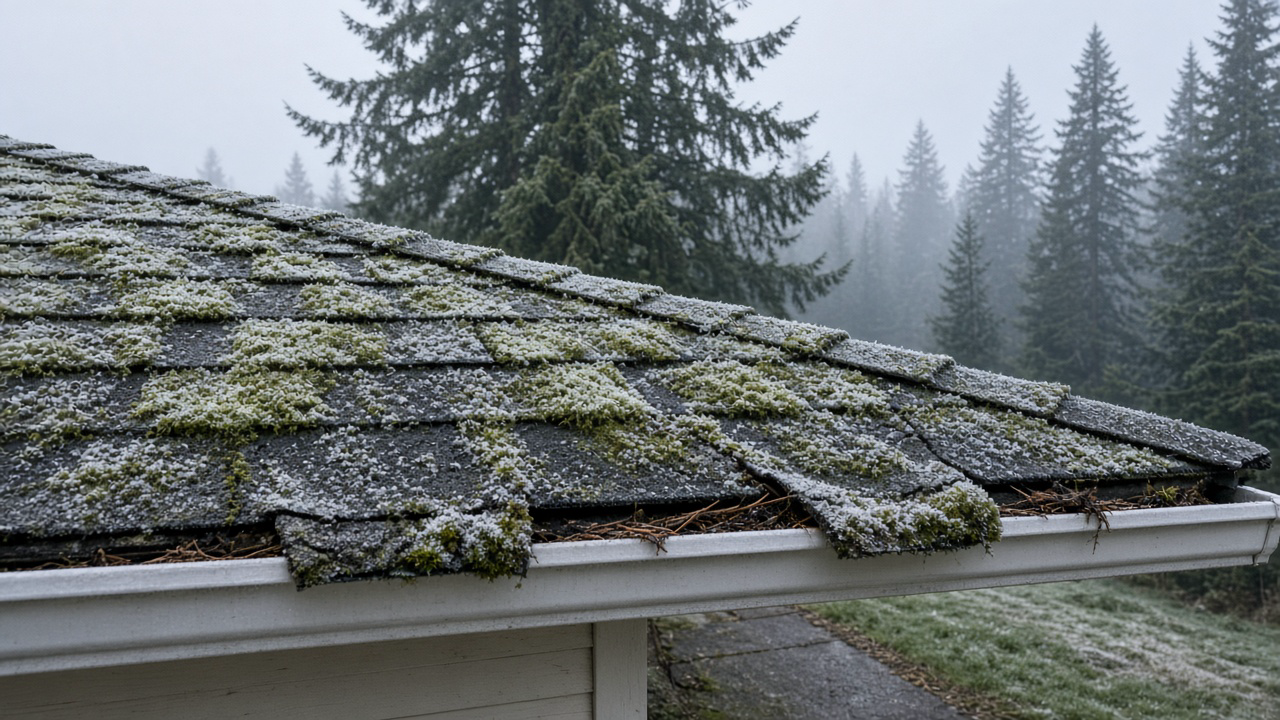
By the last week of October a clear night after Island rain can put the first frost of the season on a Nanaimo roof. If the slope is already mossy, that frost does not sit on a dry shingle. It sits in water the moss has been holding against the tab.
The water freezes overnight and lets go by late morning. Each cycle works the edge. Tabs that were lying flat start to lift. The slope is slick with rime and with a film of ice under the green, even when the street looks only damp. A scraper on frozen moss tears the mineral surface off a cold shingle.
Stay in the yard. Nanaimo receives over 1,100mm of rain a year, and November stacks more of it on a roof that no longer sheds cleanly. Halloween is Saturday, October 31. Clocks fall back on Sunday, November 1, so the eave is dark on the way home. The useful plan is a booked visit before December, not a ladder on a frosted morning.
How moss holds water against the shingle
A bare asphalt tab sheds a shower and dries between rains. A moss cushion on the same tab drinks the water and keeps it. The growth sits in the seam, under the leading edge, and anywhere a Douglas fir or a western red cedar keeps the pitch in shade. After the rain stops, the green is still wet when the open shingles have gone dull.
That stored water is what a frost exploits. The timing guide for roof moss after the fall rains is about how the mat thickens. A night below freezing is the next step, with that reservoir still against the tab.
The lower courses stay damp longest
Water runs down the pitch and stops in the mat at the eave. That band is the one you can see from the driveway, and a frost reaches it first. It is thin, open to the air, and already soaked. The curl starts there.
Tree shade keeps the mat from drying before night
A lot in Nanaimo, Parksville, Lantzville, Ladysmith, Cedar or Qualicum Beach stays wet under the canopy without a hard-freeze forecast. Oceanside afternoons in late October are short. If the mat is still spongy at dusk, it has water in it for the night.
What a freeze and a thaw do to the edge
Water expands when it freezes. A thin film on a bare tab is nothing you will see from the yard. A moss mat pressed to that tab gives the ice something to push against. The leading edge lifts a little. The thaw by late morning lets water back into the gap the ice opened. The next clear night repeats the same push.
One clear night after a soaking rain is enough. That pattern shows up through November whenever a system clears. Cold asphalt bends less than it does on a mild afternoon. A tab that would flex in September can crack when it is frosted and something pries it.
The curl you can see from the driveway
A lifted edge catches the light. From the yard it reads as a dark line, or as a pale underside, along the eave, often with moss still hooked under the tab. Water that used to run off now has a shelf. The next frost uses it.
Granules can come loose with the ice
A mat that freezes to the mineral surface can pull granules when it shifts, even if nobody has been on the roof. A light sprinkle of grit in the gutter is a reason to look from the ground. Bald patches, or a fresh pile at the downspout, belong with the granule guide. Leave the grit until a booked visit. Do not rake the edge.
Why a frosted mossy roof is a slippery roof
The risk is not only the white you can see. Moss holds a film that freezes clear, and the green looks much as it did yesterday. Boots and a ladder assume a surface that grips. On a frosted mat it does not.
Leave the ladder down. The deck and stairs guide covers the walk and the steps. The roof is the surface you do not test with a foot. White tips at dawn, and a mat that is still stiff after the grass has thawed, mean the sponge is still there. Brown tips later are not a clean roof.
Why scraping frozen moss makes the damage worse
Frozen moss is bonded to the granule surface. A shovel, a stiff broom, a putty knife, or a plastic ice scraper does not lift a plant off a shingle. It lifts the mineral coat, and often the tab the coat is stuck to. Cold shingles crack where a warmer one might flex. A torn tab is a repair. No wash puts that tab back.
The method that belongs on a sound asphalt roof is a soft wash. Moss removal and roof cleaning use an eco-friendly biodegradable solution at low pressure, time for it to work, then a controlled rinse. High pressure strips granules and can drive water under the laps. Pressure washing belongs on the walk the eave has been soaking, not on the shingles. Soft washing is the roof approach.
A frost morning is the wrong hour to treat
Leave the mat until there is a gap between weather systems. The solution needs a damp roof, not a sheet of ice. Cracked or missing tabs, visible decking, or a ceiling stain after the last rain go to a qualified roofer before any wash. Cleaning is not roof repair.
A soft wash does not empty the gutter the same day. Treated growth loosens over the following weeks and joins the cedar scales and Douglas fir needles already in the trough. Gutter cleaning on the same visit includes a full downspout flush.
What to check from the ground, and what to plan before December
Pick a daylight hour and leave the ladder in the garage. The first hour after a frost is useful, and so is the afternoon once the rime has left the grass. You are comparing the edge, not climbing it.
- White tips that hide a green mat. The frost is on the sponge. The moss underneath is still thick.
- A lifted or curled tab at the eave. A dark line or a pale underside, with growth hooked under the edge. The next frost will sit on that shelf.
- A sheen that is not just a wet shingle. Ice in the mat looks dull and stiff. If you cannot tell, stay off it.
- Grit in the gutter after a clear night. A new sprinkle of granules, with nobody on the roof, can mean the mat shifted as it froze.
- Moss over the lip, and a full trough. A spilling gutter wets the fascia and the walk. Roof and gutter belong on one visit.
- A sag, a split, or soft fascia. That is a repair. Photograph it and leave the metal alone. Cleaning is not gutter repair.
Why December is the wrong time to start
November keeps sending clear nights between systems, and each one works a mat that is still in place. December adds shorter days and ladders for lights. A lifted tab is a poor place for a clip. The Christmas lights guide is about that edge. Book a gap before then, on a roof that is not iced.
On a sound roof, zinc strips go on the ridge after moss removal. The site FAQ says most Nanaimo roofs stay moss-free for 3–5 years with soft wash and those strips. Strips do not unstick a frozen mat, and they do not fix a cracked tab.
A simple order for this week
- Walk the eave in daylight. Lower courses, lifted tabs, grit in the trough, the fascia, and the walk. Note which side stays shaded under fir or cedar.
- Separate a frost-lifted edge from a failed roof. A green mat on sound shingles can be soft-washed. Cracked tabs, missing shingles, exposed decking, or a ceiling stain go to a qualified roofer first.
- Leave frozen moss where it is. No shovel, no broom, no scraper.
- Book roof and gutters together, before December. Say if the shaded side is hidden from the street. House washing can wait until the eave stops feeding the siding. Glass there is a window washing job once the grit stops washing down.
The same eave shows up under fir and cedar in Parksville, Lantzville, Ladysmith, Cedar and Qualicum Beach.
Frost on the moss, a cracked tab, or a gutter that is only full
Match what you can see from the yard on one morning, and name it on the quote. A house can have more than one of these at once.
| What you see from the ground | What it usually means | Sensible next step |
|---|---|---|
| White frost on thick green moss, tabs still flat | The mat held water, and that water froze | Soft wash in a weather gap. Do not scrape |
| Lifted or curled tabs, moss hooked under the edge | Freeze and thaw have started to open the edge | Soft wash if the shingles are sound. A roofer if tabs are cracked or missing |
| Fresh granules in the gutter, nobody on the roof | The mat shifted as it froze and took grit with it | Look from the ground. A roofer if patches are bald |
| Moss over the lip, water staining the fascia | The roof is feeding a full trough | Roof cleaning and a full downspout flush together |
| A stiff sheen you cannot read from the yard | The slope is slick, white tips or not | Stay off it and book. Do not test the edge |
Questions from the driveway
Will the first frost kill the moss? It can brown the tips. The mat stays and still holds water. The next clear night freezes that water against the same tabs.
Can I scrape it once the frost has melted? A thawed mat is still rooted in the granules. A stiff brush pulls the mineral coat off. Wait for a soft wash on a sound roof.
Is late November too late? Book the gap you can get before December. A leak, or shingles already cracked and missing, goes to a qualified roofer first.
Book the roof before December frosts stack up
See the eave from the yard, leave frozen growth alone, and book a soft wash and a gutter flush before December works the same edge again. A cracked shingle or a rotten fascia still goes to a qualified contractor first.
On the quote form you can choose Gutter Cleaning, Roof Cleaning & Moss Removal, House Washing / Soft Washing, Multiple Services, or Not Sure — Just Need a Quote. Ground-level photos of the frosted or lifted eave, the gutter lip, any grit at the downspout, and the shaded side under the fir or cedar help us size the job before we arrive. We serve Nanaimo, Parksville, Lantzville, Ladysmith, Cedar, Qualicum Beach and surrounding central Vancouver Island communities, fully insured, with eco-friendly biodegradable soft-wash solutions on roof work. House jobs start from residential services.