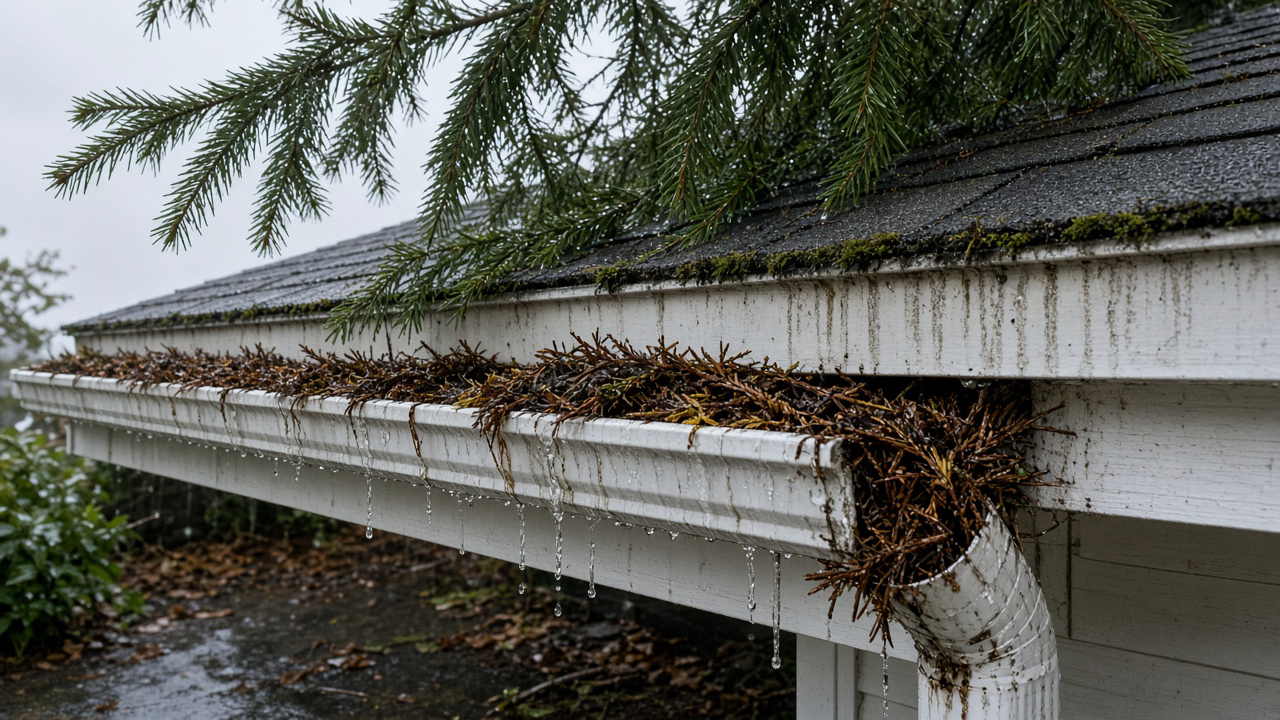
Halloween is Saturday, October 31. The bigleaf maples and red alders around Nanaimo have mostly let go. Douglas fir and western red cedar have not. They drop through the wet month, heavier after wind, and they are still dropping when Remembrance Day arrives on Wednesday, November 11.
A gutter cleared in October can look finished from the driveway and still take a fresh needle load with every system. Nanaimo receives over 1,100mm of rain a year. November is when that rain stops moving loose debris and starts packing it. Damp needles felt together, bridge the outlet, and collapse into the downspout.
This post stays on that pack: fir and cedar in the trough and in the pipe, after the hardwood leaves are down. The mid-October cedar needle flush is the second look while the mat is still loose. The maple and alder guide is the leaf lid on top of it. The downspout guide is the first heavy rain. This one is the month that follows.
Why fir and cedar keep shedding after the maples are bare
A hardwood street finishes in a window. An Island lot under Douglas fir and western red cedar, in Nanaimo or along the Oceanside, does not. Scales and needles sieve down all month, ride the next wind off the branches, and land in the corners that already caught the October load.
Cedar scales lie flat and stick when wet. Fir needles spear into that mat and close it after the next shower. The trough fails from another wet week under the tree, with no new maple leaf required.
Where the November load lands first
The street face can stay thin. The run under the drip line fills: a north eave in Lantzville, a treed street in Parksville, a shaded side in Cedar, and lots in Ladysmith and Qualicum Beach. North Nanaimo does the same where a fir leans over the back gutter.
A guard changes less than it looks from the ground. Fine needles ride over or through the mesh and build underneath, which is why gutter guards still need cleaning here.
How November rain packs a trough that still trickled in October
In a dry spell, needles sit loose and water finds a channel to the downspout. A half-full trough can pass a light October shower, which is why a mid-month clean sometimes feels optional.
November takes away the dry hours between systems. Rain does not hose needles out of a residential gutter. It presses them flat, washes shingle grit into the gaps, and sends water over the front lip because that path is easier than the outlet.
The outlet is where the felt turns solid
The open run can still look fine from the lawn. The failure is the last foot before the drop, the end cap, and the corner where two runs meet. Scales stack, a fir needle bridges the hole, and the next debris seals it. You see a sheet at one corner while the rest of the eave looks ordinary.
Moss on the lower courses feeds that corner. If those pitches are thick, moss removal and roof cleaning belong with the trough. A soft wash does not empty the gutter the same afternoon. Treated growth loosens later and joins the needles in the pipe, so book the two jobs together. Raking a wet edge only moves the moss into the outlet.
The downspout takes what the gutter cannot hold
A gutter is a trough. A downspout is a pipe with turns. November packs both.
Needles from the first heavy rains settle where the water slows: the upper elbow under the eave, a joint behind the fascia, and the lower elbow at the splash block or the soil. An October flush proved the pipe was open that day. By the second week of November the same elbow can hold a fresh wad, with a new mat on the outlet above it.
A full pipe and a packed trough overflow differently
If the downspout still drips while water sheets off the lip, the trough is holding the rain and the pipe is still moving some of it. If the gutter is full, one spout sits idle while the others run, or the pipe gurgles, the elbow is the suspect. Both show up on the same house in one week. A scoop of the open channel misses the pipe.
Gutter cleaning here is a debris clear and a flush of every downspout. Leaves, pine needles, shingle grit and organic debris come out by hand and with blowers. Water has to leave at the bottom elbow in a steady stream, including a second-storey run. A hose aimed at the lip drives needles deeper into the turn. Wet ground and a short day make that upper run a booked visit, not an evening ladder job.
What a November shower shows from the yard
Stay off the ladder. A one-storey eave is still a fall on wet metal. Clocks fall back on Sunday, November 1. Look in daylight, during or just after a normal shower.
- A brown pillow at one corner. Scales and fir needles at the outlet, while the rest of the run looks thin.
- Water sheeting over that corner. Other runs may still drain. Overflow at one outlet usually means the drop or the pipe is packed.
- A spout that barely drips. The others run in the same shower. This one is idle and the gutter above it is full.
- Gurgling at the lower elbow. An open downspout pours. A partial plug gulps.
- A tide mark on the fascia. Dark streaks under the lip, or grit on the concrete, stay after the rain.
- Soft soil at the foundation. Water that missed the pipe returns with the next system. A damp lower wall or a wet crawlspace vent means it is reaching the house.
Twice a year fits this rainfall: late fall after the leaves drop, and again in spring. November is the late-fall window under fir and cedar. Repeated overflow is how fascia rot, foundation flooding and siding deterioration get started. Clearing the pack does not replace wood that is already soft.
What to book this month, and what is a repair
Worth doing before the pack sets
- Runs under fir or cedar cleaned in September or mid-October. Assume the outlets took another load. Watch where the water leaves.
- A corner that sheets while the rest of the house drains. The plug is in the trough, the pipe, or both.
- A guarded gutter on a treed lot. Clean under the guard. A tidy mesh does not mean the outlet is open.
- The downspout that soaked the walk in the first storm. A flushed pipe under trees can fill again. One that was never flushed goes solid this month.
- A sound roof shedding into that trough. Soft washing uses an eco-friendly biodegradable solution at low pressure. Clear the gutter the same visit.
Hand it to a qualified contractor first
- A sagging section, a pulled joint, or a missing end cap. Cleaning is not gutter repair. Water leaves at the gap anyway.
- Fascia that is soft or stained through. Brightening the face does not replace the board. A carpenter comes before a ladder hangs on that edge.
- A crushed, disconnected, or buried downspout. A plug can be cleared. Rebuilding how water leaves the foundation is a contractor's job.
- Cracked shingles, a lifted tab, or a ceiling stain. Those go to a roofer. Cleaning is not roof repair. High pressure does not belong on shingles.
Streaks on the siding below that corner are a house washing job after the gutter stops feeding them. Brightening the outside of the metal is separate from the flow inside.
How the November flush fits the rest of the house
Order is what keeps a finished surface from getting dirty again the same week.
- Roof and moss work first when the pitches above the packed run are green. Soft wash, dwell, then a low-pressure rinse. Pressure washing belongs on sound concrete, brick and pavers, not on a needle-packed gutter and not on a roof.
- The clear and a full downspout flush so November runoff, and anything the roof sheds afterward, does not sit in the trough through December.
- Glass and the walk after that. A spilling corner throws grit onto the panes and a wet fan onto the path. Window washing at that wall waits until the lip stops overflowing.
If lights go on the fascia later, the trough has to carry water first. The Christmas lights guide covers the roof and the clips. A gutter packed with fir is not a step. A shared eave starts from commercial services.
What the corner is telling you
A house can match more than one row. Brown needles are the November pack. Whole leaves still flat on the lip are the late-October lid.
| What you see from the yard | What it usually means | Sensible next step |
|---|---|---|
| Brown pillow at one outlet, that corner sheets | Fir and cedar packed at the drop | Clear the trough and flush that downspout |
| Gutter full, one spout idle or gurgling | Needles in the elbow or down the pipe | A full downspout flush, not a scoop of the run |
| Maple or alder leaves still flat on the lip | A leaf lid over the needle felt | Clear the leaves and the felt, then flush |
| Mesh looks clear, fascia under it still stains | Needles packed under a guard | Clean under the guard on a treed lot |
| Sagging run, soft fascia, or a pulled joint | A repair, not a debris pack | A qualified contractor before a clean will hold |
Questions from the driveway
We had the gutters done in October. Why would November matter? Fir and cedar did not stop when the crew left. The flush proved the pipes were open that day. A wet month under those trees puts a new mat on the outlet and a new wad in the elbow.
Will November rain rinse the needles through? Rain moves loose debris. It packs a damp mat tighter and carries the fines into the turns. A corner that trickled in mid-October can sheet by Remembrance Day.
Can the same visit include the roof? Yes, when the pitches are green and the shingles are sound. Soft wash first, then the clear and the flush. Cracked tabs or a ceiling stain go to a roofer before any of that.
Book the November flush before the pack sets
Look up from the yard the next time it rains. A brown pillow at one outlet, an idle spout, or a tide mark on the fascia is the November pack. Book the clear and the flush before that overflow spends the winter on the wall. A sagging section, rotten fascia, or a failed shingle goes to a qualified contractor first. Cleaning is not that repair.
On the quote form you can choose Gutter Cleaning, Roof Cleaning & Moss Removal, House Washing / Soft Washing, Window Washing, Pressure Washing, Multiple Services, or Not Sure — Just Need a Quote. Ground-level photos of the packed corner, the lower elbow, the fascia, and the tree over that run help us size the job before we arrive. We serve Nanaimo, Parksville, Lantzville, Ladysmith, Cedar, Qualicum Beach and surrounding central Vancouver Island communities, fully insured, with eco-friendly biodegradable soft-wash solutions on roof work. House jobs start from residential services.