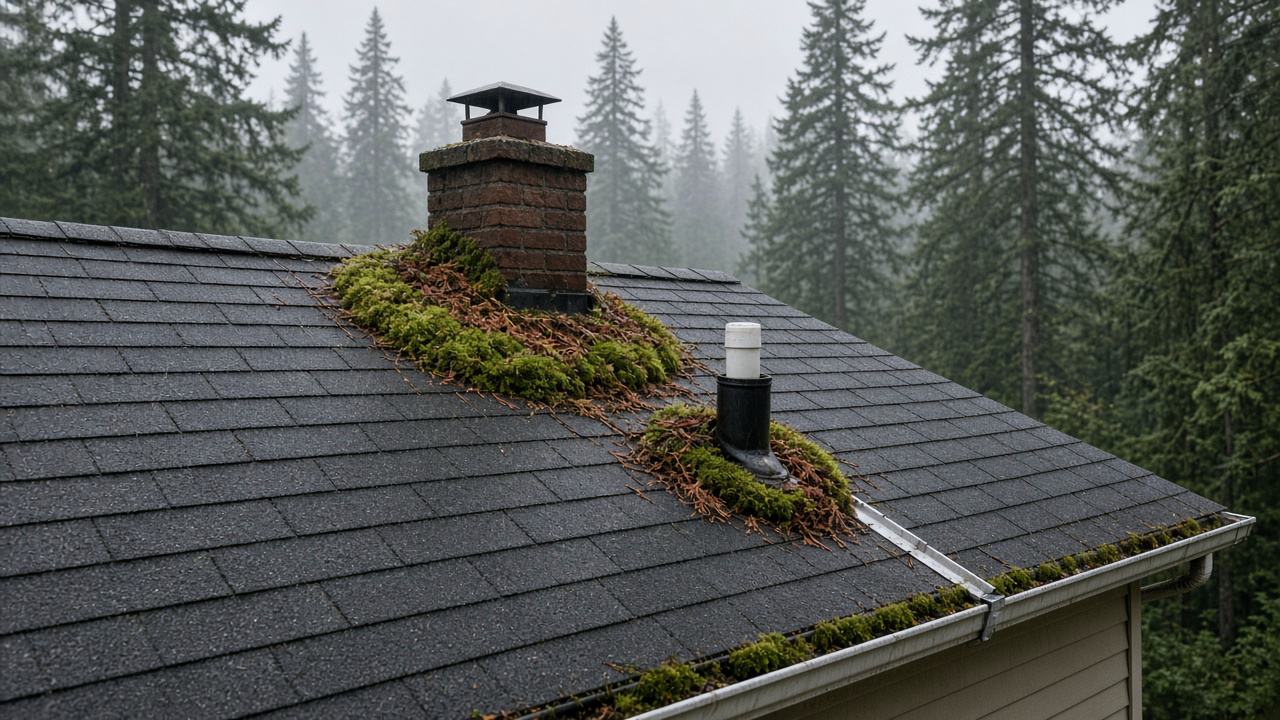
By the last week of October, the open slope of a Nanaimo roof can still look like a faint green haze. The growth that matters is the collar you can see from the driveway: the uphill side of the chimney, the ring around a plumbing vent, and the line where a lower roof dies into a wall. Those spots catch the needles and cedar scales the rest of the pitch sheds. Once the pile stays damp, moss fills it in.
Valleys and skylight curbs have their own piece, the valleys and skylights guide. This one stays with the metal: chimney flashing, the boot on a plumbing vent, and the step flashing and kickout where a roof meets a wall. A moss mat there can hold water against the laps as the winter rains start, on houses in Nanaimo, Parksville, Lantzville, Ladysmith, Cedar, Qualicum Beach and the Oceanside, under Douglas fir and western red cedar.
Stay off the roof while you look. Wet moss is slick, and binoculars or a phone from the yard are enough. Nanaimo receives over 1,100mm of rain a year, and the cool months are when a roof stays wet between systems.
Why chimneys, vents and wall joints trap debris
An open shingle sheds. A chimney, a vent pipe and a wall stop the flow. Wind drops fir needles and cedar scales on the uphill side, and the pile stays damp after the open slope has dried. Moss follows that damp. It shows under tall trees in Lantzville, Cedar and parts of Ladysmith, and on more open lots in Parksville and Qualicum Beach, where one chimney is still a shelf.
The chimney is a shelf
Brick, stone, or a framed chase, debris lands on the uphill face. Some roofs have a cricket that splits water around the stack. Many do not, so the flashing sits nearly flat and needles pack on it. Moss then bridges onto the metal and a short way up the masonry. If the tree side is hidden from the driveway, say so.
The plumbing vent is a small dam
A plumbing vent is a pipe with a rubber or metal boot at the shingles. The boot is a low ring. Cedar scales sit in it, and moss creeps up the pipe. A boot that is cracked, curled, or slid down the pipe is a roofing detail you can often see from the ground. Moss removal does not replace it.
The roof-to-wall joint stays in the shade
A porch, a garage, or a one-storey wing usually dies into the taller wall. Step flashing is woven with each shingle course and covered by siding or counterflashing. A kickout at the bottom should throw water into the gutter, not behind the wall. That line sits in shade, especially on the north and east and under a cedar at the eave, and moss grows there in a stripe. A kickout that is missing, flat, or buried gives that water a path onto the siding.
How a moss collar can push water under flashing
Flashing works by overlapping. Water should run over the upper piece, onto the next, and onto the shingle. It gets into trouble when water sits against a lap, or when a dam sends it sideways into a gap.
A moss collar is that dam. Needles and living moss on the uphill side of a chimney hold rain the open shingles have shed, so water sits at the metal. Through a long November system it can work under a lifted counterflashing edge, under a dried boot, or behind step flashing where a shingle has curled. Along a wall joint the same stripe can lift an edge enough that water slips under the course through a wet winter.
Once the rains stack up, the house reports a collar in a few places: a ceiling stain beside the chimney or a vent, a dark fan on the siding under a wall joint, overflow at only that gutter corner, or fresh grit at the downspout. A stain inside, or bald patches with a fresh pile of granules, is a roofer before any wash. The granule guide sorts ordinary wear from a fresh pile. A soft wash takes the sponge off sound metal. It does not reseat flashing, close a split boot, or rebuild a kickout.
What you can safely spot from the ground
Walk the yard with binoculars or your phone. A second-storey window helps if it faces the chimney. Leave the ladder down.
At the chimney
- A green or brown ring on the uphill side. Compare its thickness with the open shingles beside it.
- Moss bridging onto the metal, or needles with little green. A film is early. A packed shelf will hold the next rain either way.
- Rust, a lifted edge, or a gap in the counterflashing. Photograph it and leave the metal alone.
At each plumbing vent
- A dark ring at the base, or green up the pipe. The pipe is fine. The boot ring is staying wet.
- A boot that is cracked, pale and split, or slumped. Note it on the quote. Treatment does not seal rubber.
- Which slope it sits on. A pipe under cedar on the north side fills first.
At the roof-to-wall line
- A green stripe where the lower roof meets the wall. Follow the run into the side yard, not only the end you see from the sidewalk.
- The kickout. It should angle out over the gutter. Flat, missing, or buried is the note.
- A stain on the siding, or a gutter that spills only there. The joint and the trough belong together.
Photograph from the yard, name the side of the house, and send that set with the quote.
Why the last week of October is the time
The heavy part of the Island rain year is ahead. A green ring now is a wet sponge once November systems line up, and the wind drops fresh fir and cedar on the uphill side of every obstacle. The timing guide for roof moss after the fall rains covers when a whole roof is worth treating. Flashing details follow that calendar. Water held against metal is how a small collar becomes a stain, so a thick one has less room to wait.
A first frost can brown the tips and still leave the mat in place. Clocks fall back on Sunday, November 1, so you see less of the roof on the commute home. Halloween weekend is a poor time for a ladder on wet shingles. If holiday lights are planned, clear the collar and the trough on a booked visit.
A simple order for this week
- Look from the ground. Chimney, each vent, and every roof-to-wall line. Name the side of the house.
- Separate growth from a failed detail. Tight metal with a green ring can be treated. A split boot, open flashing, or a ceiling stain is a roofer first.
- Book a break, and include the gutters. A soft wash needs time before a controlled rinse. Gutter cleaning on that visit includes a full downspout flush. Cleaning is not gutter repair.
What a visit can do at these details
On a sound roof the work is a soft wash: eco-friendly biodegradable solution at low pressure, time to work, then a controlled rinse. High pressure can strip granules and drive water under laps. Moss removal and roof cleaning check asphalt, cedar shake, and metal separately. Growth on sound flashing, at the collar, the vent, and the wall line, can be treated. The crew does not bend metal, caulk a boot, or rebuild a kickout.
Zinc strips go on the ridge afterward. The site FAQ says most Nanaimo roofs stay moss-free for 3–5 years with soft wash and those strips. Needles at a chimney or wall joint can shorten that. Strips do not repair flashing or empty a gutter. See the zinc strip guide.
Book the gutter when the collar feeds a corner. A kickout should land in the trough. Cedar packed in that trough sends the water over the lip or behind the fascia, and a full downspout flush shows whether the elbow is open. A hanging gutter or rotten fascia needs a qualified contractor. The same joints show up from Ladysmith and Cedar through Lantzville, Parksville and Qualicum Beach.
Siding stains under the joint can wait for house washing or soft washing until the roof stops feeding them. Glass beside a chimney is a window washing job once the grit is dealt with. Pressure washing is for a walk or a driveway, not for shingles, flashing, or a vent boot.
Collar, boot, or wall joint: what to do next
Match what you can see from the yard, and name that spot on the quote.
| What you see from the ground | What it usually means | Sensible next step |
|---|---|---|
| Green ring uphill of the chimney, metal still tight | A debris shelf, moss bridging onto the flashing | Soft wash on a sound roof. Name the chimney |
| Moss on the masonry, flashing lifted or rusted | Growth, plus a question about the metal | A roofer first. Cleaning once the metal is sound |
| Boot cracked, curled, or slid down the pipe | The seal at the pipe is failing | A roofer replaces the boot. A wash will not seal it |
| Kickout missing or bent, stain on the siding | Water leaving the roof behind the wall | A roofer or siding contractor. Cleaning will not close it |
| The gutter spills only under that corner | The joint is shedding into a packed trough | A gutter clear and downspout flush, plus the roof if the collar is thick |
Questions from the driveway
Can I pull the moss off the flashing myself? Leave it. Scraping takes the top and leaves the roots, and a tool under the metal can open a lap.
Will a soft wash force water under the flashing? The work stays at low pressure, with time for the solution and a controlled rinse, on a sound roof. High pressure is what drives water under shingles and flashing.
What if November is already wet? A break between systems still works on a sound roof. Water inside, or a split boot, goes to a roofer first. A thin film can wait for early spring. A thick collar feeding a wall joint should take the first workable day.
Book a look at the flashing details
A moss collar at a chimney, a plumbing vent, or a roof-to-wall joint holds a large share of the water in a small area. See it from the ground this week, and book a soft wash on a sound roof before the wetter stretch keeps that sponge against the metal. Open flashing, a split boot, or a stain inside comes first, with a qualified contractor.
On the quote form you can choose Gutter Cleaning, Roof Cleaning & Moss Removal, House Washing / Soft Washing, Multiple Services, or Not Sure — Just Need a Quote. Ground-level photos of the chimney's uphill side, each plumbing vent, the roof-to-wall line, the kickout, and the gutter under that corner help us size the job before we arrive. We serve Nanaimo, Parksville, Lantzville, Ladysmith, Cedar, Qualicum Beach and surrounding central Vancouver Island communities, fully insured, with eco-friendly biodegradable soft-wash solutions on roof work. House jobs start from residential services.