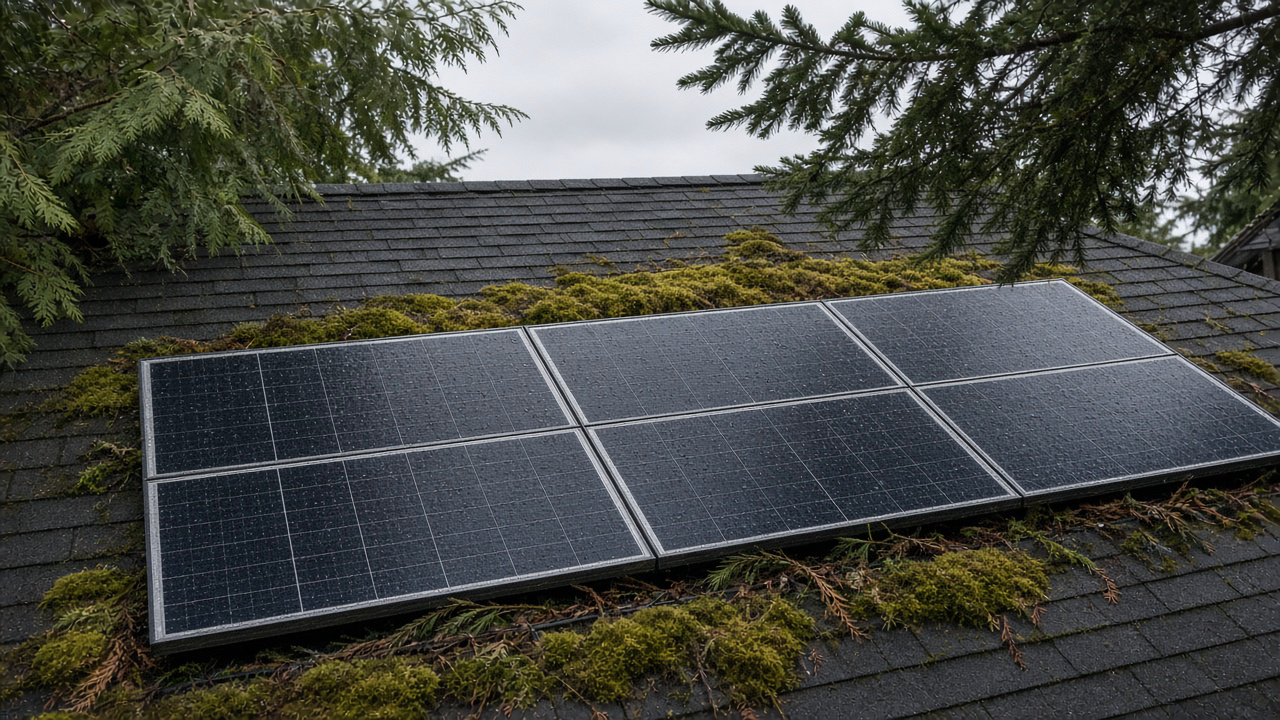
Clocks fell back on Sunday, November 1. By mid-afternoon the sun is already low over Nanaimo, and a solar array that carried the house through summer is working a short, grey day. Glass that looked clear in June now holds a film you notice because the light is scarce.
Under Douglas fir and western red cedar, that film is moss at the frame, a mat of needles between the rows, and a grey-green grime that rain wets and does not rinse off. Nanaimo receives over 1,100mm of rain a year. November is when the sun sits lowest and the roof stays damp between systems, from Nanaimo out through Parksville, Qualicum Beach and the rest of the Oceanside.
This post stays on the array and the shingles right around it: how moss, needles and grime cut the little light you get, what you can see from the yard, and when a clean is safe. Roof cleaning and moss removal are for the roof. The glass follows the panel maker's care sheet. Cleaning is not electrical work, and a lifted mount or a stained ceiling under the array is a repair.
Why the film matters more in November than it did in July
A speck of pollen is easy to ignore on a long June day. On a short November day the sun never climbs high enough to shrug a shadow off the glass. After the clocks change, useful light is a late-morning to early-afternoon slice, often under cloud.
Even at midday the sun sits low. A fir, a chimney, or a band of moss along the bottom of a module throws a long shadow across the cells. A north slope already lives in that shade. The north-facing roof guide is the shingle version. An array on that side, or under a cedar that now reaches the ridge, spends November working inside its own shadow.
Rain wets the film and leaves it there
A November shower does not hose a framed module clean. Water beads on the grime, needles stick where the frame stops them, and moss at the lower rail stays wet after the open shingles have shed. By Remembrance Day on Wednesday, November 11, a roof that was only dusty in September can hold a felted line along every lower edge.
What actually lands on a Nanaimo array
The glass is smooth. Debris stops where the roof is interrupted: the frame, the gap between two rows, the rail, and the shingles uphill of the rack.
Moss at the frame and under the rail
Moss likes the damp line where a module meets the shingle, the shaded lower edge, and the gap under the rail. It holds water against the asphalt and creeps onto the glass from below. On a treed lot in Lantzville, Cedar or Ladysmith, that line is often green before the open south face of the house is.
Fir and cedar needles between the rows
Douglas fir needles and western red cedar scales collect between two rows, along the bottom frame, and in the little valley the rack creates. A dry wind moves them. A wet week felts them into a pillow. Pollen, needle dust, a thin algae film and, on an ocean-facing lot, salt haze dull the glass the same way. The same trees feed the gutter under that eave, which is why a November needle pack in the trough and a needle pillow on the array often show up together.
How a little shade becomes a short day
An even film lets less light through. A band of shade does more. Modules on a house array are wired together, so a needle mat across the bottom of one panel, moss on one corner, or a branch across a single row can pull that string down further than the covered patch suggests. Bypass diodes limit some of the loss. A shaded cell still does not produce, and one stuck in deep shade while the rest of the module is lit can run hotter than the cells around it.
When a clean is worth doing, and when to wait
Early November still has mild, dry gaps between systems. That gap is the window. An array that is already filmed is worth doing before the roof stays wet for days at a time.
A useful day this month
- Cool glass. Wash on an overcast morning, or later on a mild day once any sun has left the array. Cold water on hot glass can stress a module. November is kinder for that than a July noon.
- A dry, frost-free roof. Wet shingles beside the rack are slick, and moss is slicker. Wait until the surface has dried and any morning frost has gone.
- Between systems. Rinsing in a heavy rain only pushes needles deeper into the frame. Book a dry gap, including a weekday before Remembrance Day if that is when the roof is actually dry.
Stay on the ground
Do not walk on the modules. A foot can crack the glass, and a wet frame is a poor step. A one-storey eave is still a fall. From the ground, photograph the lower frame, the gap between the rows, the shingles above the rail, and any cracked glass or ceiling stain.
What belongs on the glass, and what does not
Read the care sheet that came with the modules before anyone puts water on them. Makers differ. Many allow plain water and a soft brush or cloth on cool glass, and they rule out pressure, abrasives and solvents.
- Plain water and a soft tool. A soft brush or cloth on cool glass, working downward so grit leaves the frame.
- Leave the pressure washer on hard surfaces. A close jet can crack glass, drive water under the frame, and strip granules beside the array. Pressure washing belongs on sound concrete, brick and pavers.
- Skip blades and scouring pads. A scraper or steel wool leaves a scratch for the life of the panel. Soften droppings and stuck needles, then brush.
- Keep roof solution off the modules. Soft washing uses an eco-friendly biodegradable solution at low pressure on shingles and siding. Tell the crew the array is there.
- Leave any row you cannot reach safely. Standing on the glass cracks modules. A second-storey array needs a proper setup.
What the roof is telling you
The glass, the shingles and the gutter are three jobs on one eave.
| What you see from the yard | What it usually means | Sensible next step |
|---|---|---|
| Moss on the lower frame and on the shingles above the rail | The roof is feeding the glass, and the ledge stays wet | Soft-wash sound shingles. Keep solution off the glass. Leave the mounts alone |
| Grey film on the glass, no thick moss | Dust, pollen, algae or salt haze on the cells | Cool-glass rinse with plain water and a soft tool, as the maker allows |
| Needle pillow between rows or along the bottom rail | Fir and cedar felted where the frame stops the wind | Lift loose debris without prying the frame, then flush that gutter |
| Cracked glass, a lifted mount, or a ceiling stain | Damage at the module or the roof penetration | Installer or a qualified roofer first. Cleaning is not that repair |
| Green streaks on the siding under that eave | Overflow from a packed gutter or from moss at the edge | Clear the roof and the gutter, then wash the wall |
The roof and the gutter around the array
Growth uphill of the rack sheds onto the glass with every storm. A rinse that leaves a moss mat above the rail lasts until the next rain.
On sound asphalt, the roof job is a soft wash: low pressure, an eco-friendly biodegradable solution, and a rinse that follows the shingles. The moss-removal FAQ says that, combined with zinc strips, most Nanaimo roofs stay moss-free for 3-5 years. That claim is about the shingles. Shade under the modules brings an edge line back sooner than on an open slope. Zinc strips after moss removal covers where a strip cannot reach under a rail.
Roof moss after the fall rains return is the wider calendar. Around an array, keep the solution off the glass and leave the rails, clamps and flashed feet alone. A leak at a mount is a roofer or the installer. Cleaning does not reseat a penetration, so a booked repair happens first.
The trough under that eave
Needles off the glass, and moss that loosens after a soft wash, land in the gutter. Gutter cleaning with a full downspout flush belongs on the same visit, after the roof work. A hose aimed at the outlet drives the felt into the elbow. Water has to leave at the bottom in a steady stream.
A sensible order
- Roof growth first on sound shingles beside the array. Solution stays on the roof. Mounts stay put.
- Loose debris next, lifted without prying the frame. Any glass rinse follows the maker's sheet: cool glass, plain water.
- Gutters and every downspout under that eave, so November rain has a way off the roof.
- The wall last. House washing waits until the lip stops spilling onto the siding.
Questions from the driveway
Will November rain clean the panels? Rain moves loose dust. It packs needles into the frame and leaves the film in place. A module that looked clear in September can wear a grey band by mid-month.
Can the driveway wash include the array? Glass and asphalt mark under a close jet. The roof around the panels is a soft-wash visit, with the glass kept out of that solution. The driveway can be washed on its own day.
Will a rinse fix a low reading? It takes off film and debris you can see. Clear glass and a poor number are a question for the installer, whether the cause is an inverter, a loose connector, or a fir across the sun path.
Do you soft-wash the panels? Soft wash is for moss on the roof. The glass follows the manufacturer's care sheet, usually plain water and a soft tool on cool glass. Say the array is there so the wash stays off the modules.
Book the roof around the array before the dark stretch settles
Look up from the yard on the next dry morning. A green line at the lower frame, needles felted between the rows, or moss on the shingles above the rail is the November problem on a solar roof. Book the roof and the gutter while a mild gap still exists. Cracked glass, a lifted mount, or a ceiling stain goes to the installer or a qualified roofer first. Cleaning is not that repair.
On the quote form you can choose Roof Cleaning & Moss Removal, Gutter Cleaning, House Washing / Soft Washing, Window Washing, Pressure Washing, Multiple Services, or Not Sure — Just Need a Quote. Ground-level photos of the array, the moss at the lower frame, needles between the rows, the gutter under that eave, and any cracked glass or ceiling stain help us size the job before we arrive. Note that panels are on the roof. We serve Nanaimo, Parksville, Lantzville, Ladysmith, Cedar, Qualicum Beach and surrounding central Vancouver Island communities, fully insured, with eco-friendly biodegradable soft-wash solutions on roof work. House jobs start from residential services.