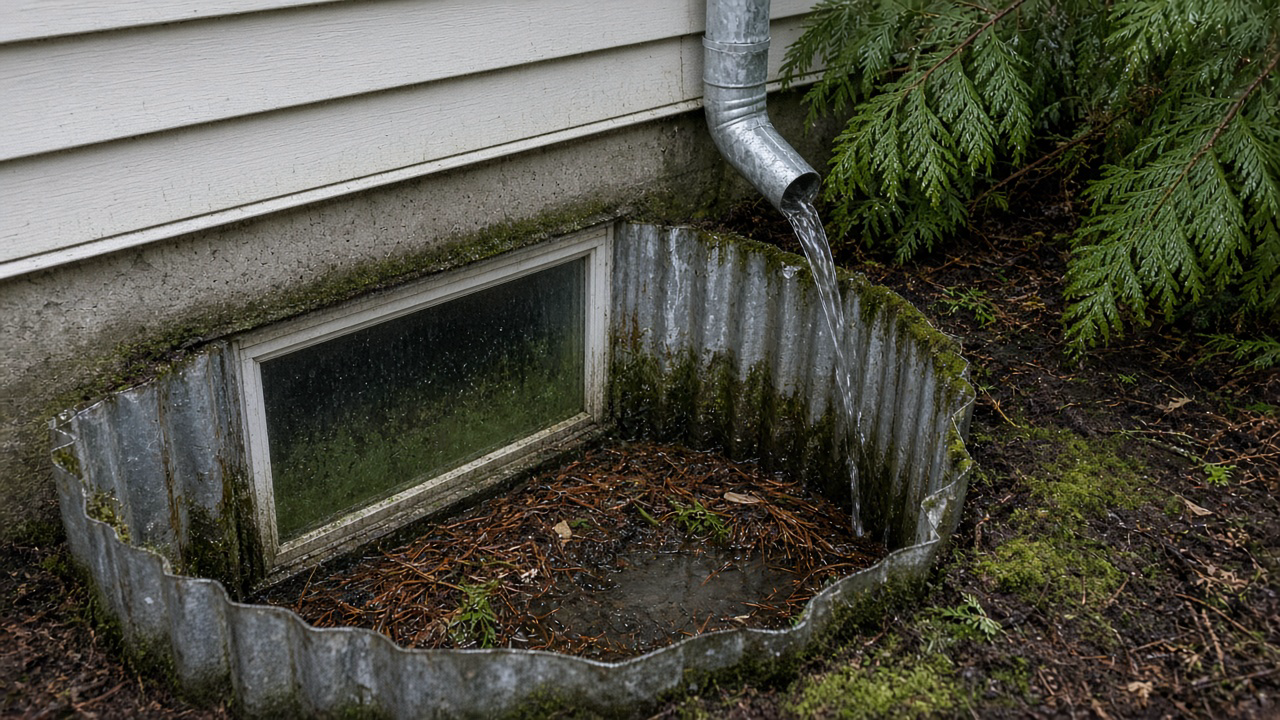
Tuesday, November 10, and the window well is still holding water after the shower. The lawn beside it has lightened. The pit at the basement pane has not. Douglas fir needles and cedar scales sit in a mat over the gravel, and the glass is green along the bottom.
Steady rain does not rinse that well. It keeps a thin algae coat on the liner and packs the next drop of needles onto the same shelf. Nanaimo receives over 1,100mm of rain a year, and mid-November is when short days, and a first frost on a clear dawn, stop a shaded foundation from drying between systems.
This post stays on the window well: the liner, the gravel, the standing water, and the basement glass. The stain on the wall above grade, where a gutter spills onto siding, is the foundation splash guide. Needles in the trough are the November needle guide. A dim main-floor room behind a dirty screen is a different opening. Cleaning is not a new well, a new drain, or a new window.
Why the well stays full once November evenings go dark
A September afternoon still puts light on a south foundation. After the clocks changed on Sunday, November 1, that wall is in shade by mid-afternoon, and a north side under western red cedar may not see the sun at all. The ring can look dry from the path while the gravel is still holding last night's rain.
A shelf cut into the grade
The siding above sheds. The well does not. It is a shelf so a basement window can see out. Rain lands in it, splash off the liner runs to the low corner, and a needle mat keeps that water off the drain. Corrugated metal holds a black film in the ribs. Plastic takes the same coat, and a close jet can crack a liner that has gone brittle. Concrete holds moss in the joint at the house. A film on the lower pane is enough to dim the room by four o'clock.
The pane, and the cover over it
The liner is what you notice from the path. The glass is what the room uses. Algae films the lower pane first, where the water sits. A cover keeps some of the drop out and still lets a seep in at the edge. Leaves on a cover look like a lid. Under it, the gravel can be a pond you cannot see from the walk. Do not step on the cover. A wash will not replace one that has split, or a drain under the gravel that no longer takes water.
Shade, a first frost, and the rooms that use this glass
North Nanaimo and Lantzville often have Douglas fir or western red cedar over the side yard, so the well sits in drip all month. Parksville and Qualicum Beach add Oceanside damp. Ladysmith and homes in Cedar see the same dark gravel.
A clear dawn can put a white skin on water that was open at midnight. Leave the ice. Remembrance Day is Wednesday, November 11, and early holiday visits start the same week. A basement suite or a guest room uses this pane while the street face of the house still looks fine. The porch light does not show the film.
A downspout that dumps at the well, or an extension that has slipped and points at the pit, feeds that one corner while the wall above looks ordinary. If the water comes from a packed trough, gutter cleaning with a full downspout flush belongs with the well. A pipe that backs up at the elbow is the downspout guide. The trough and the pit are two shelves. Clearing one does not empty the other.
The liner, the gravel, and the pane
The metal ring is what you see from the path. The water sits inside it, on the gravel, in the low corner, and against the glass. Shade, drip, and needles meet there, so the pit stays wet after the lawn has shed.
Where the growth actually sits
On corrugated metal, algae films the ribs and moss takes the rim where soil meets the steel. Plastic holds a green coat that looks painted on. A poured well or a concrete-block cheek wall holds moss in the joint. The gravel hides the outlet. An open outlet leaves the needles damp and the pit empty. A packed outlet, or no outlet at all, leaves a pond against the pane.
A dark band only on the siding above the well means the gutter is feeding the wall. That stain belongs with the splash guide. Do not treat a green liner as proof the sash has failed, and do not treat a soft, stained sill as a film you can wash off.
What you can see from the yard
Stay at the rim. Do not step into a well, and do not stand on a cover. Leave the ladder down. A wet roof is not part of this check. After a shower, look into the pit in daylight from the path. The colour on the glass is one clue. Water that is still there an hour later is the other.
- Gravel that stays dark after the lawn has lightened. That shelf is holding water.
- A pond against the pane, needles or not. The outlet is not keeping up.
- Green or black film on the liner, the rim, and the lower glass. That is why the room looks dim.
- Douglas fir needles and cedar scales matted over the gravel, or a lid of leaves on the cover. They hide the drain. Do not stand on the cover to look.
- A white skin at dawn on standing water. Leave it. Do not chip ice off the glass.
- A downspout or a loose extension aimed at the well. The pit is being fed from the roof.
- A split cover, a liner pulled away from the wall, or a soft, stained sill. The film is a wash. The gap and the sill are not.
Metal, plastic, concrete, and glass are not the same wash
One foundation often has a metal well, a plastic cover, a concrete rim, and a wood or vinyl window on the same afternoon. A close jet that suits sound concrete will crease a cold plastic liner and drive water at a sash that is already tired.
| What you see at the well | What it usually means | Sensible next step |
|---|---|---|
| Moss or black film on a sound metal liner or concrete rim | Growth on a hard surface that can take a rinse | Soft wash, then a gentle rinse. Keep a close jet out of the pit and off the glass |
| Green film on a plastic well or a plastic cover | Algae on a liner that can crack when it is cold | Soft wash and dwell. Pressure can split the plastic |
| Green film on the basement glass, sash sound | Algae and needle dust on the pane | Clear the pit first, then window washing so the rinse does not recoat the glass |
| A pond and a needle mat, liner still sound | The outlet or the grade is not taking the water | Lift loose needles from the rim, then flush the gutter. A buried line that will not drain is a contractor |
| A dark band on the siding only where a gutter spills | The wall above the well is being soaked from the trough | Open the gutter and the downspout, then wash that splash. The wall is a separate pass |
| A split cover, a liner pulled off the wall, a rotten sill, or water inside | A repair, with film on top of it | A qualified contractor before a wash will hold |
Do not scrape the glass or the liner to hurry the colour. A knife or a wire brush takes the finish and leaves growth in the ribs. On the pane it can scratch the glass you were trying to clear.
What a careful clean looks like
Mid-November still has mild gaps between systems. Rain mid-visit rinses a treatment off before it has worked, so the solution needs time to sit. A frost at dawn means the rim may be icy first thing. Book the gap, and leave the ice alone.
Treat the growth, then rinse where the surface can take it
Soft washing puts an eco-friendly biodegradable solution on the growth at low pressure and leaves time for it to work. That is the start on metal, on plastic, on a concrete rim, and on film that has crept onto the lower sash. A close jet in the pit drives water at the glass and packs needles onto the outlet.
Pressure washing belongs on sound concrete beside the well after the film has been treated, and only where the rinse will not sheet into an open sash. A blast on its own stripes the rim and leaves growth in the pores. Keep it off plastic, off the glass, and off a sill that already shows soft wood. House washing on the siding above is a separate pass.
A sensible order when the pit is being fed
- The water path first. If a gutter or a slipped extension dumps into the well, flush that downspout and aim the extension away from the pit before the glass is the finished surface.
- Roof growth next, if it sheds into the well. On a sound roof, moss removal and roof cleaning come first. The site FAQ says most Nanaimo roofs stay moss-free for 3-5 years with soft wash and ridge zinc strips. That claim is about the shingles, not this pit. Failing shingles go to a roofer. Stay off the slope.
- Loose needles out of the pit, from the rim, without stepping in and without packing the mat onto the drain. A cover comes off only if it lifts from the side.
- The liner and the rim, solution where the growth is living, then a rinse the material can take. Siding above waits until the splash stops.
- The glass last. Window washing is that pass. A screen in the well comes out, gets cleared, and goes back only when it will not print dirt on the pane.
Name a bed, a pond, or a rain barrel beside the foundation before the rinse. The garden, pets, and rain barrel guide is the longer note. A well that serves a strata suite, or a row of them along a common wall, is commercial services. If the week of Wednesday, November 11, is solid rain, book the next opening so the solution can sit.
What a wash will not fix
A clear pane is easier to live with on a short day. It is not a repaired drain, and an open pit will still take rain.
A failed outlet stays failed
A crushed buried line, a liner pulled away from the concrete, a sill that gives under a light press, or water already inside the room is contractor work. Book that repair first. A crew can wash a sound liner and wash the glass. They cannot rebuild a drain, reset a well that has left the wall, or dry a basement that is already wet. If you can see staining on the inside of that window, say so before anyone arrives, and skip the heavy rinse.
Clean glass is not a dry well
A wash removes moss, algae, and the loose mat. It does not install a cover, a new extension, or a drain that was never there. November is a reset before the dark stretch, not a dry pit until spring. Fir keeps dropping onto the grade after the trough is flushed. If a clear night ices the rim, stay off it. Cleaning is not a dry basement.
Questions from the side yard
Will November rain wash the well clean? Rain wets the film and floats a few loose needles. It also delivers the next mat. A pit that looked dusty in October can hold a pond by the second week of the month.
Can a close jet replace a treatment? On sound concrete beside the well, pressure lifts dirt after the growth has been treated. In the pit it drives water at the sash and packs needles onto the outlet. Plastic and the glass take soft washing and a window wash.
The gutters were cleaned in October. Why is the well still full? A gutter clean stays in the trough. Fir and cedar keep dropping onto the grade, and an extension that has slipped still points at the pit. The needle guide is the trough. This is the shelf at the glass.
Does a clear pane mean the basement stays bright and dry? It removes moss and algae that dim the glass. Shade, a short day, and a needle lid on the cover can still leave the room dull. A wash does not add a drain. Water inside is a repair.
Book the wells before the dark stretch settles
After the next shower, walk the foundation once in daylight and stay at the rim. Gravel that stays dark, a pond against the pane, or glass filmed green along the bottom is the November problem in a window well. Book that pit and that glass while a mild gap still exists. A split liner, a soft sill, or water already inside goes to a contractor first. Cleaning is not that repair.
On the quote form you can choose House Washing / Soft Washing, Pressure Washing, Roof Cleaning & Moss Removal, Gutter Cleaning, Window Washing, Commercial Services, Multiple Services, or Not Sure — Just Need a Quote. Ground-level photos of the well, the glass, the gravel, and any downspout or extension aimed at the pit help us size the job before we arrive. Note whether the liner is metal, plastic, or concrete, and whether a cover is on it. Say if you can see standing water, and if a plant bed, a pond, or a rain barrel sits beside the foundation. We serve Nanaimo, Parksville, Lantzville, Ladysmith, Cedar, Qualicum Beach and surrounding central Vancouver Island communities, fully insured, with eco-friendly biodegradable soft-wash solutions where the growth needs treatment before a rinse. House jobs start from residential services.