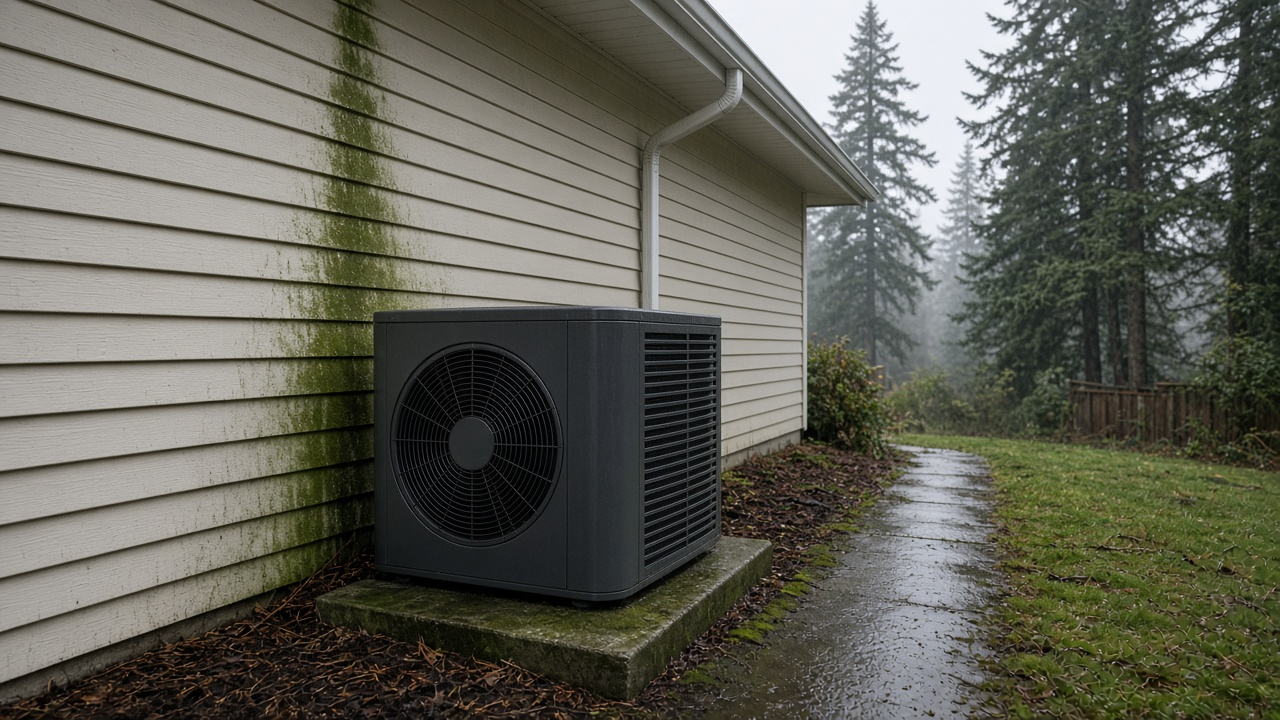
Thursday, November 19, and the side yard is still wet. The outdoor heat pump has been running. The pad under it is dark and slick, with Douglas fir needles in the gap against the wall. The vinyl in that shadow has a green film the rest of the course does not.
Early fall was the time to wash the open walls. Late November is the week that unit stays on for heat, and the trees keep dropping scales into a gap you notice after dark. Nanaimo receives over 1,100mm of rain a year. A cabinet under western red cedar holds that damp between systems.
This post stays on that corner: the pad, the needle gap, and the film on the wall the unit shades. Glass on a roof array is the solar panel guide. Streaks across a whole north wall are the north-wall guide. A stripe only under a spilling downspout is the foundation splash guide. Moss at a skylight, a roof vent, or chimney flashing is the chimney and vent guide. We wash film on sound concrete and sound siding. We do not service the heat pump, open the cabinet, or straighten a fin.
Why that pad stays wet once the heat is on
A heat pump outdoors is a fan, a coil, and a cabinet on a small slab. In a milder month the slab can dry between showers. In late November the fan runs, the rain keeps coming, and the slab sits in the shade the cabinet and the trees throw together.
Water the unit sheds onto its own pad
On a colder night the outdoor coil can ice, then clear. That melt lands on the pad, often under the cabinet. Rain adds to it. A bare slab sheds it. A filmed slab, or needles packed against the wall, holds it, and the green thickens where it sits. Ice that never clears is a technician. A wash does not defrost a unit.
Needles the trees keep delivering
Douglas fir needles and western red cedar scales do not stop because the gutters were done in October. The same trees fill the trough, which is the November needle guide, and the gap behind the cabinet. The fan pulls a share against the coil. A wet week packs them into a shelf.
Shade that corner does not leave
North Nanaimo and Lantzville often tuck the unit under fir. Parksville and Qualicum Beach add Oceanside damp, then the cabinet shades the wall behind it. Ladysmith and homes in Cedar see the same dark pad. A white edge at dawn is still algae once the frost lifts. Ice from a packed gutter is the cold-snap guide.
How a needle shelf holds water against the wall
The open siding sheds. The gap behind the cabinet does not. It is a few inches of still air, the pipes where they enter the wall, and whatever the trees have dropped since the last clear week.
The gap is a shelf
Needles stack against the siding, under the back of the cabinet, where a broom does not reach. Moss follows that damp, and the bottom course stays wet after the rest of the wall has aired. Under cedar the shelf can be brown more than green and still hold water.
Where the pipes enter the wall
The lines and the drain enter the cladding low, in that same gap. A buried opening has needles packed against the hole, so water sits on the seal. A soft course, a stain spreading from the hole, or caulking that has left the pipe is a repair. A wash will not reseal it, and a close jet can drive water in.
A downspout that shares the slab
Some pads sit under an elbow. A packed gutter lands overflow on the same concrete, so the film is fed from the eave as well as from the coil. Gutter cleaning with a full downspout flush belongs first. Cleaning is not gutter repair. Moss off the roof above is moss removal and roof cleaning on sound shingles, at low pressure. The crew stays off a wet slope.
What you can read from the side path
Walk the side once while the pad is wet and the light is low. A bright noon hides the film. Stay on the ground. The top of the cabinet is not a step. Leave the ladder down.
- The pad itself. Green film on sound concrete, slick under a shoe, is algae on a slab that does not dry. If the path beside it is clean, the unit's shade and the water it sheds are the reason.
- The gap. Look along the back without leaning on the cabinet. A brown shelf of needles, or moss bridging onto the siding, is what holds water against the wall.
- The wall in that shadow. Film only behind the unit is this corner. Streaks on the whole elevation are the north-wall job.
- The pipes at the wall. A slipped cover, or a stain that starts at the hole. Photograph it. Leave the cover on.
- The gutter above. Needles at the lip, or an elbow aimed at the pad, means the trough is feeding the slab.
- What has failed. A heaved pad, a leaning cabinet, folded fins, or ice that does not clear is not a wash. A slick gate past the unit is the side-gate guide.
A slick pad and a struggling unit are not the same job
A close jet that suits a sound driveway can fold the fins, drive water into the hole at the wall, and soak the electrical side of the cabinet. Living film on a sound slab and a unit that will not clear its own ice are not the same booking.
| What you see beside the unit | What it usually means | Sensible next step |
|---|---|---|
| Even green film on a sound, level concrete pad | Algae where the slab stays wet under the cabinet | Soft wash, then a controlled rinse, with the wand off the fins |
| Needles and moss packed in the gap, siding still sound | A shelf holding water against the wall | Lift the loose debris by hand, then soft-wash the courses it kept wet |
| One dark stripe from a gutter or an elbow onto the pad | The trough is soaking the slab | Flush the gutter and the downspout, then wash the film it was feeding |
| Film only on the courses directly behind the unit | Shade and splash in that alcove | Soft wash those courses. A whole-wall streak is a house wash |
| A heaved pad, a leaning cabinet, bent fins, ice that stays, or a stain from the pipe hole | A repair, with debris on top of it | An HVAC technician or a contractor before a wash will hold |
Soft washing puts an eco-friendly biodegradable solution on the growth at low pressure and leaves time for it to work. Pressure washing belongs on sound concrete after that, with the fan and the fins clear of the jet. See soft washing versus pressure washing. House washing on the courses behind the unit is the soft wash. The cabinet is not a driveway.
What to clear before guests use the side path
Thursday, November 26, is Thanksgiving in the United States, and December visits follow. It is dark before supper. That side path reaches a suite, a gate, or the backyard, and a slick pad reads as a wet leaf until a shoe slips.
- The water path first. If a gutter soaks the pad, clear the trough and flush the downspout before the slab is the finished surface.
- Loose needles in the gap, by hand. Bag them. Do not blow them into the coil or pry a cover.
- The film on the sound concrete. Soft wash the pad and leave the dwell. A rental wand on living algae smears the green and leaves it in the slab.
- The courses the shelf was wetting, on sound vinyl, fibre cement, or paint. Keep the rinse moving down, away from the pipe hole.
- Sound concrete last, outside the cabinet. Pressure on a tight, level pad after the treatment. Ease off at the fins, the fan, the siding, and any plant.
Name a plant bed, a pond, or a rain barrel beside the pad before anyone rinses. The garden, pets, and rain barrel guide is the longer note. If this week is solid rain, book the next opening. We do not open the electrical cabinet, and we do not wash a coil cased in ice.
What a wash will not fix
A cleaner pad is easier to walk past. A unit that short-cycles, ice that stays, a tripped breaker, or a cabinet on a heaved slab is technician work. A crew can lift loose needles, treat film on sound concrete, and soft-wash sound siding. They cannot recharge a system, replace a pad, reseal the pipe opening, or straighten a bent fin. If a gutter still spills on the slab, the green returns. Cleaning is not an HVAC visit, and it is not gutter repair.
Questions from the side yard
Can I hose the needles out of the back of the unit? A light rinse of loose needles off the pad is fine if the hose stays out of the fan and off the fins. A jet into the coil bends the metal. Leave a packed shelf, and the cover on the pipes, for a visit.
Will November rain rinse the pad clean? Rain wets the film and moves a few loose needles. It does not clear algae on a shaded slab, and it packs a dry pile into a shelf.
Should the unit be off while you wash? Tell us where the disconnect is. We do not open the cabinet. Ice that stays is an HVAC call.
Why is the strip behind the unit green if the wall was washed in September? November keeps that one course wet. The rest of the wall can still look fine.
Book the pad while a mild gap still exists
After the next shower, walk the side while the pad is wet. A slick green slab, a needle shelf, or film only in the cabinet's shade is the late-November problem there. Book sound concrete and sound siding while a mild gap exists. A heaved pad, ice that stays, or a stain from the pipe hole goes to a technician or a contractor first.
On the quote form you can choose House Washing / Soft Washing, Pressure Washing, Roof Cleaning & Moss Removal, Gutter Cleaning, Window Washing, Commercial Services, Multiple Services, or Not Sure — Just Need a Quote. Ground-level photos of the pad, the gap behind the cabinet, the wall in that shade, the pipes where they enter, and any downspout aimed at the slab help us size the job before we arrive. Note whether the pad is poured concrete or pavers, whether the cladding is vinyl, fibre cement, or paint, and whether a plant bed, a pond, or a rain barrel sits beside the unit. Say if the pad has heaved, if the cabinet leans, or if the coil is iced. We serve Nanaimo, Parksville, Lantzville, Ladysmith, Cedar, Qualicum Beach and surrounding central Vancouver Island communities, fully insured, with eco-friendly biodegradable soft-wash solutions where the growth needs treatment before a rinse. House jobs start from residential services. A shared pad at a strata starts from commercial services and the commercial quote.